
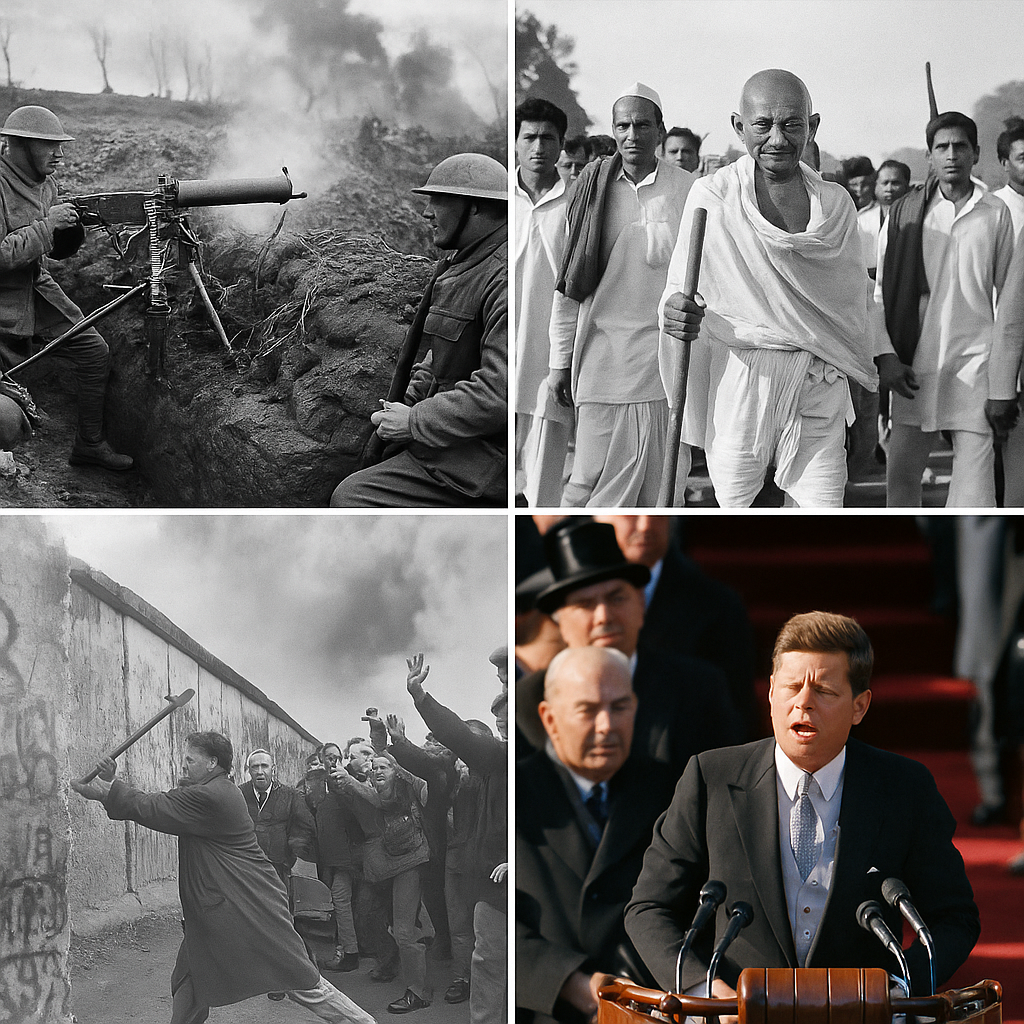
Modern History
Explore modern history resources for students, covering major events, movements, and global developments from the 18th century to today—designed to build critical thinking and global understanding.
Modern History: Cold War and Postcolonial Transformations
Introduction
The modern era, defined largely by the aftermath of World War II, saw a dramatic reordering of global power. With the collapse of European empires and the rise of two superpowers—the United States and the Soviet Union—the global system was reshaped by ideology, decolonization, and emerging alliances. These developments were not merely military or diplomatic; they impacted national identity, economic development, and the structure of global governance.
Two interconnected forces dominated this post-war world:
- The Cold War, a period of sustained ideological conflict between capitalism and communism
- The wave of decolonization, which gave birth to dozens of new states navigating independence amidst Cold War pressure
Together, these dynamics created a multi-polar, contested, and transformative global order that still shapes geopolitics today.
1. The Cold War: Ideological Rivalry and Strategic Containment
Theoretical Foundations
- Realism: Interprets the Cold War as a power struggle between two hegemonic actors seeking balance through deterrence, alliances, and nuclear superiority.
- Constructivism: Emphasizes how ideology, identity, and narrative framing shaped foreign policy decisions and public discourse.
- Post-revisionism: Recognizes that both superpowers bore responsibility, moving beyond blaming one side.
Core Characteristics
- Bipolarity: The division of global influence between NATO and the Warsaw Pact.
- Mutually Assured Destruction (MAD): The logic of nuclear deterrence underpinned strategic behavior.
- Proxy wars: Direct conflict was avoided between superpowers, but they fought through aligned states (e.g., Korea, Vietnam, Angola).
- Espionage and psychological warfare: Media, culture, and science became battlegrounds.
Case Study: The Cuban Missile Crisis (1962)
In October 1962, American reconnaissance discovered Soviet missile installations in Cuba. Over 13 tense days, the world teetered on the brink of nuclear war. The crisis ended when Khrushchev agreed to withdraw missiles in exchange for a U.S. promise not to invade Cuba—and the secret removal of U.S. missiles from Turkey.
- Realist interpretation: Classic case of brinkmanship; both sides sought to preserve strategic balance.
- Constructivist angle: The narrative of American vulnerability reshaped domestic policy (e.g., Civil Defense programs) and international posturing.
The crisis was not just an event—it became a symbol of Cold War danger and restraint.
2. The Global Impact of the Cold War
While the Cold War’s central axis was U.S.-USSR, its influence was global. Ideological polarization reshaped political alignments in Latin America, Africa, and Asia.
Key Effects
- Military interventions: U.S. operations in Latin America (e.g., Chile 1973), Soviet invasion of Afghanistan (1979).
- Development aid and soft power: Marshall Plan (Western Europe), COMECON (Eastern Bloc), and educational/cultural exchanges.
- Space race and science: The USSR’s launch of Sputnik (1957) triggered massive U.S. investment in technology and education.
Case Study: Vietnam War
The Vietnam War was framed by American policymakers as a line in the sand against communism (Domino Theory). However, it also reflected Vietnamese nationalism, anti-colonial resistance, and civil war dynamics.
- Key lessons: Overreliance on ideology obscured complex local realities.
- Legacy: The war tarnished U.S. credibility, radicalized global youth movements, and reshaped military doctrine.
3. Decolonization: Redrawing the Global Map
Foundations and Theories
- Anti-colonial nationalism: Inspired by Enlightenment ideals, self-determination, and the post-WWI rhetoric of Woodrow Wilson.
- Dependency theory: Argues that post-independence nations remained economically dependent on former colonial powers.
- Constructivist approaches: Focus on how new national identities were formed and contested.
Key Phases of Decolonization
- South and Southeast Asia (1945–1957)
- India (1947), Pakistan (1947), Indonesia (1949), Vietnam (1954)
- Africa (1957–1975)
- Ghana (1957), Nigeria (1960), Algeria (1962), Angola & Mozambique (1975)
- Caribbean and Pacific (1960s–1980s)
- Jamaica (1962), Papua New Guinea (1975)
The decolonization wave was often peaceful (India, Ghana), but in other cases violent (Algeria, Kenya, Vietnam).
Case Study: Algerian War of Independence (1954–1962)
Algeria’s fight against France involved:
- Guerrilla warfare by the FLN (National Liberation Front)
- Systematic torture and mass repression by French forces
- Global attention, including from the UN and anti-colonial movements
The war ended with the Evian Accords and Algeria’s independence. It deeply affected French society and shaped debates on post-colonial migration and memory.
4. The Rise of the Non-Aligned Movement (NAM)
Origins and Purpose
Founded in 1961 in Belgrade by leaders like Tito (Yugoslavia), Nehru (India), and Nasser (Egypt), NAM aimed to:
- Avoid siding with either Cold War bloc
- Promote development, sovereignty, and peaceful coexistence
- Strengthen Global South solidarity
Principles
- Respect for sovereignty and territorial integrity
- Non-interference in domestic affairs
- Peaceful resolution of conflicts
- Mutual cooperation
NAM offered newly decolonized nations a collective voice in global affairs, often using forums like the UN General Assembly to advocate for disarmament, development, and racial equality.
5. Structural and Economic Outcomes of Postwar Transformation
Economic Shifts
- Bretton Woods Institutions: The creation of the IMF, World Bank, and GATT aimed to stabilize postwar economies but also entrenched Western dominance.
- Planned economies in the USSR and China struggled to innovate under rigid controls.
- State-led development in the Global South varied: success stories (e.g., South Korea) contrasted with stagnation and debt crises (e.g., Latin America, Sub-Saharan Africa).
Social Transformations
- Civil rights movements in the U.S. and anti-apartheid movements in South Africa echoed post-colonial struggles.
- Global student protests (1968) reflected discontent with both capitalist and communist systems.
- Women’s liberation and environmental movements began asserting themselves globally in the 1960s and 1970s.
6. The Cold War Ends: Transition to a Unipolar World
Key Developments
- Perestroika and Glasnost under Gorbachev weakened the Soviet system.
- Fall of the Berlin Wall (1989): A symbolic and literal collapse of East–West divisions.
- Dissolution of the USSR (1991): Marked the end of Cold War bipolarity.
Consequences
- U.S. hegemony in a unipolar world
- NATO’s continued relevance and expansion
- Post-Soviet transitions: liberal reforms, nationalism, and authoritarian resurgence (e.g., Russia under Putin)
The Cold War’s end created opportunities for cooperation—but also new instabilities, from ethnic conflicts in the Balkans to wars in the Middle East.
Conclusion
Modern history since 1945 has been shaped by two colossal forces: the Cold War’s ideological standoff and the decolonization of empires. Their legacy continues to shape:
- Global alliances
- Security doctrines
- Economic hierarchies
- National identity narratives
Understanding these case studies through theoretical lenses—realism, constructivism, dependency theory—offers insight into how power works, how identities are formed, and how states navigate global systems. The Cold War has officially ended, but its echoes—proxy conflicts, ideological polarization, strategic competition—are deeply embedded in our present.
References
Wilson Center – Cold War International History Project
https://www.wilsoncenter.org/program/cold-war-international-history-project
Gaddis, John Lewis – The Cold War: A New History
Hobsbawm, Eric – The Age of Extremes: The Short Twentieth Century, 1914–1991
Westad, Odd Arne – The Global Cold War
Said, Edward – Culture and Imperialism
Young, Crawford – The African Colonial State in Comparative Perspective
Chomsky, Noam – Hegemony or Survival
SpringerLink – “Decolonization and the Cold War”
https://link.springer.com/chapter/10.1007/978-3-030-38200-1_3
Council on Foreign Relations – “The Cold War”
https://www.cfr.org/timeline/cold-war
Britannica – “Non-Aligned Movement”
https://www.britannica.com/topic/Nonaligned-Movement
The United Nations: Power, Peace, and the Postwar World Order
Introduction
In 1945, as the world emerged from the devastation of World War II, global leaders recognized a grim truth: without a new system of cooperation, humanity risked repeating the catastrophes of the early 20th century. Out of that necessity, the United Nations (UN) was born—an ambitious experiment in international diplomacy, collective security, and multilateral governance.
For over 75 years, the UN has been both praised and criticized. It has mediated wars, advanced human rights, overseen decolonization, and responded to pandemics. Yet it has also been paralyzed by veto power, criticized for bureaucracy, and challenged by global inequality. This article explores the UN’s formation, its foundational structure and ideals, its role during the Cold War, and its continuing global relevance.
1. Founding and Purpose
Background and Context
The UN was created on October 24, 1945, when 51 nations signed the UN Charter in San Francisco. The horrors of the Holocaust, the nuclear bombings of Hiroshima and Nagasaki, and the failures of the League of Nations underscored the urgency of building a more effective framework for peace.
The UN was conceived not just as a peacekeeping body, but as a platform for cooperation, a voice for weaker nations, and a guardian of human dignity. Its goals were shaped by four key aims:
- To maintain international peace and security
- To develop friendly relations among nations
- To promote human rights and economic development
- To serve as a center for harmonizing international action
The UN combined both realist and idealist elements. Realist, because the permanent powers (USA, USSR, UK, France, China) held veto authority in the Security Council. Idealist, because it affirmed collective dialogue, global equality, and moral obligations.
2. UN Structure and Core Institutions
The United Nations functions through a multi-organ system:
A. The General Assembly
- Composed of all 193 member states, each with one vote
- Debates global issues, passes resolutions (non-binding)
- Important for setting norms, especially for newly independent states during decolonization
B. The Security Council
- Responsible for international peace and security
- 15 members: 5 permanent (P5) and 10 rotating elected members
- Can authorize sanctions, military force, and peacekeeping
- The P5 (USA, Russia, China, UK, France) hold veto power
C. The International Court of Justice (ICJ)
- Settles disputes between states, offers legal opinions
- Based in The Hague
D. The UN Secretariat
- Led by the Secretary-General, the UN’s public face and chief administrator
- Provides diplomatic mediation and policy guidance
E. Specialized Agencies
- WHO (health), UNESCO (education, science, culture), UNDP (development), UNHCR (refugees)
- Act as global coordination hubs for long-term goals and crisis response
3. The UN in the Cold War Era
A. Deadlock and Diplomacy
The Cold War (1947–1991) posed a fundamental challenge to the UN’s peacekeeping mandate. Bipolar rivalry between the US and USSR led to frequent deadlock in the Security Council, especially over:
- Berlin Blockades (1948–49)
- Korean War (1950–53)
- Suez Crisis (1956)
- Hungarian Revolution (1956)
- Afghanistan invasion (1979)
Vetoes were common. Between 1946 and 1989, the USSR used its veto over 120 times, mostly to block Western-backed resolutions.
B. General Assembly as a Global Forum
While the Security Council was often gridlocked, the General Assembly became a stage for global voices, particularly during decolonization:
- Newly independent countries used it to promote anti-imperialism and racial justice
- The “Zionism = racism” resolution (1975), later revoked, showed rising influence of the Global South
- The Assembly passed numerous declarations on self-determination, human rights, and economic equity
C. Peacekeeping Evolution
Cold War constraints gave rise to “Chapter VI½ operations”—peacekeeping missions that operated in a legal gray area:
- First UN Peacekeeping force: UNEF I, deployed during the Suez Crisis (1956)
- Peacekeepers were lightly armed, impartial, and required host nation consent
- Missions in Congo (1960), Cyprus (1964), and Lebanon (1978) reflected a balancing act between intervention and neutrality
4. Decolonization and Global South Leadership
A. UN and Decolonization
Between 1945 and 1975, more than 70 countries gained independence. The UN:
- Supervised referenda (e.g., Namibia, Western Sahara)
- Set international standards on self-determination and sovereignty
- Provided technical assistance through the UNDP
B. The Group of 77 and New Economic Order
In 1964, 77 developing countries formed the G-77 to coordinate their positions at the UN:
- Advocated for equity in trade, debt, and development aid
- Called for a New International Economic Order (NIEO) in 1974
- Demanded regulation of multinational corporations and fairer commodity pricing
The UN thus became a battleground for economic justice and North–South dialogue, even if many goals remained unmet.
5. Post-Cold War Role and Global Governance
A. Reinvigoration in the 1990s
The collapse of the Soviet Union reduced veto usage, enabling the UN to act more decisively:
- Gulf War (1991): UN authorized use of force against Iraq’s invasion of Kuwait
- Peacekeeping expanded: missions launched in Cambodia, Rwanda, Somalia, and Bosnia
- Challenges emerged: failures to prevent genocide in Rwanda (1994) and Srebrenica (1995) led to major criticism
B. New Mandates
- Responsibility to Protect (R2P): doctrine developed after the 1990s genocides to prevent crimes against humanity
- Millennium Development Goals (MDGs) and later Sustainable Development Goals (SDGs) defined the UN’s 21st-century agenda
- Climate Change Agreements: through UNFCCC, the UN facilitated the Kyoto Protocol (1997) and Paris Agreement (2015)
6. Criticisms and Limitations
Despite its achievements, the UN has faced persistent challenges:
- Security Council reform: Critics argue the P5 structure is outdated. Countries like Germany, Japan, India, and Brazil seek permanent seats.
- Veto abuse: Used to block humanitarian interventions in Syria and condemnations of aggression
- Bureaucratic inefficiency: Complex decision-making and political inertia slow response
- Peacekeeping weaknesses: Underfunded missions, unclear mandates, and cases of misconduct
- Dependence on powerful nations: The UN cannot enforce decisions without member cooperation
Yet even its critics admit: no alternative body has the same legitimacy, reach, or scope.
7. The UN Today: Relevance in a Multipolar World
The 21st century has ushered in new challenges:
- Pandemics (e.g., COVID-19)
- Climate disasters
- Mass displacement and refugee crises
- Disinformation and AI risks
- Geopolitical fragmentation
Amid these, the UN remains a central player in:
- Coordinating global health (WHO)
- Negotiating climate agreements (COP)
- Mediating regional conflicts (e.g., Sudan, Yemen, Libya)
- Delivering humanitarian aid through WFP and UNICEF
In a multipolar world where power is more diffuse—China, the U.S., the EU, India—the UN is not just a referee but a platform for collective problem-solving.
Conclusion
The United Nations is a flawed but vital institution. Born from the ashes of war, it has become the most visible symbol of international cooperation. While often hindered by power politics and bureaucracy, it remains indispensable for diplomacy, humanitarian action, and global goal-setting.
Its historical role during the Cold War, support for decolonization, and evolution into a platform for development and human rights make it a key actor in modern history. Understanding the UN is essential not only for studying past global dynamics—but for navigating the future of international relations.
References
UN Reform Discussion – Council on Foreign Relations
https://www.cfr.org/backgrounder/un-security-council-reform
UN Charter
https://www.un.org/en/about-us/un-charter
Britannica – United Nations
https://www.britannica.com/topic/United-Nations
UN Peacekeeping
https://peacekeeping.un.org/en
UNDP – Development Goals
https://www.undp.org
UN and the Cold War – Wilson Center
https://www.wilsoncenter.org/publication/united-nations-and-cold-war
G77 – Group of 77 History
https://www.g77.org/doc/
UN Sustainable Development Goals
https://sdgs.un.org/goals
Human Rights Council – OHCHR
https://www.ohchr.org/en/hr-bodies/hrc/home
Responsibility to Protect – Global Centre
https://www.globalr2p.org
The Changing World Order: A New Global Era in 2025
Introduction: The Age of Shifting Power
The international system of 2025 is no longer defined by a single dominant power. The U.S.-led liberal order that shaped the post-World War II era is facing intense structural transformation. New actors are asserting influence, rival systems of governance are clashing, and global cooperation is fraying. From the rise of China to the digitalization of warfare and diplomacy, every aspect of power—economic, military, technological, cultural—is shifting.
We now live in a world that is multipolar, contested, and rapidly evolving. This article explores the forces behind this changing world order, including new power alliances, emerging economies, ideological competition, the erosion of Western dominance, and the technological revolution. It also analyzes how global governance systems are responding—or failing to respond—to these shifts.
I. From Unipolarity to Multipolarity
The Collapse of Unipolar Dominance
After the Cold War, the United States emerged as the uncontested superpower. Its military reach, financial system, and cultural influence defined global norms. But in 2025, this unipolar dominance is being replaced by a multipolar framework. The rise of China, India, and regional blocs like BRICS and ASEAN has introduced competing centers of power.
While the U.S. still holds global influence, its ability to unilaterally shape world affairs has declined. Europe is inward-looking, fragmented by internal crises. China now matches the U.S. in purchasing power parity and is investing billions in global infrastructure through the Belt and Road Initiative. India has become the world’s largest democracy and a key economic engine, particularly across South Asia and Africa.
Regional Powers Reshaping Order
Power is now regionalized. In the Middle East, countries like Saudi Arabia, Iran, and Turkey assert dominance through both hard and soft power. In Africa, Nigeria, Kenya, and South Africa are growing economic and diplomatic players. In Latin America, Brazil and Mexico influence regional trade and political alignment.
This creates a world of many voices—harder to control, more prone to conflict, but more inclusive in representation.
II. Strategic Alliances and Blocs
Authoritarian Partnerships
A new bloc of authoritarian states—China, Russia, Iran, and North Korea—has emerged, challenging Western norms. They cooperate on military exercises, cyber capabilities, economic trade bypassing the dollar, and digital censorship. These countries prioritize sovereignty over human rights, order over democracy, and state-led capitalism over free-market liberalism.
This “Axis of Authoritarianism” is shaping institutions like the Shanghai Cooperation Organization and driving anti-Western narratives in the Global South.
The West’s Fragmented Unity
The U.S., EU, and their democratic allies remain powerful but increasingly fractured. NATO has expanded in response to Russian aggression, but its unity is strained by diverging security priorities. The EU’s internal divisions—on migration, energy, and foreign policy—hamper coordinated action.
Western democracies also face challenges from within: rising populism, misinformation, and political polarization undermine global leadership.
III. Economic Power Shifts
De-dollarization and Financial Realignment
The dominance of the U.S. dollar is under threat. Nations such as China, Russia, and Brazil are conducting trade in local currencies to avoid sanctions and economic dependence. Central banks are diversifying reserves, and BRICS nations are exploring alternative currency mechanisms.
Meanwhile, global supply chains are reconfiguring. The pandemic, U.S.-China tensions, and the war in Ukraine have pushed countries to favor economic self-sufficiency and regionalization over global interdependence.
Global South Rising
Once peripheral to global finance, the Global South is now demanding a seat at the table. Nations like Indonesia, Ethiopia, and Vietnam are growing rapidly and leveraging resources—labor, data, and minerals—to negotiate better terms on climate finance, trade, and technology. The G20 and World Bank face growing pressure to include more equitable representation.
IV. Technopolitics and the AI Arms Race
Data as the New Oil
Technology is now a primary vector of global power. The race to dominate artificial intelligence, semiconductors, and digital infrastructure is at the heart of modern geopolitics. The U.S. and China lead in AI research, while Taiwan remains a key producer of advanced microchips. Russia and Iran focus on cyberwarfare and information manipulation.
Nations are investing in “digital sovereignty”—controlling their own data flows, cloud infrastructure, and online ecosystems. This reshapes alliances, with countries choosing platforms and protocols based on political alignment.
Surveillance vs. Freedom
Authoritarian regimes use AI for mass surveillance, predictive policing, and dissent suppression. Democratic nations wrestle with the balance between national security and civil liberties. The global lack of AI regulation makes the technology a battleground for values and influence.
V. Climate and Resource Competition
Climate Inequality
Climate change is no longer a future threat—it’s a present crisis. Droughts, floods, and extreme heat are displacing millions. The Global South suffers most but receives the least support. Despite pledges, wealthy nations have failed to deliver the promised $100 billion annually in climate finance.
This has turned climate into a political issue of global justice. The South now demands compensation for “loss and damage,” while many northern countries prioritize adaptation over reparations.
Resource Security
Energy and minerals are geopolitical tools. Nations are competing for access to lithium, cobalt, and rare earth elements—critical for electric vehicles, batteries, and AI. China controls a significant portion of these supply chains, prompting the U.S. and EU to invest in alternative sources and green industrial policy.
Water, too, is becoming a strategic resource. In regions like the Nile Basin, Himalayas, and Central Asia, control over water access fuels diplomatic tensions and future conflict risk.
VI. Governance and Institutional Crisis
Weakening of Global Institutions
Institutions like the United Nations, World Trade Organization, and International Criminal Court are struggling. The UN Security Council remains deadlocked due to permanent member vetoes. The WTO is increasingly sidelined as nations favor bilateral or regional trade pacts.
There is a growing legitimacy gap. Citizens and states question why these institutions still reflect 1945 power structures. Reform proposals are slow, and trust in multilateralism is fading.
Rise of Parallel Structures
In response, new platforms are gaining traction. BRICS+, the African Union, ASEAN, and the Arab League are taking on broader roles. South-South cooperation is growing through development banks, regional defense pacts, and shared digital standards. The world is no longer governed by a few clubs—but by many interlinked networks.
VII. Ideological Conflict and Culture Wars
Competing Civilizations
Beyond power and money, the global order is shaped by ideas. The West promotes individual rights, liberal democracy, and open markets. China promotes state control, harmony, and performance legitimacy. Islamist movements focus on moral governance and spiritual identity. Nationalist populists advocate for sovereignty and cultural purity.
The battle is now for hearts and minds: through education, media, tech platforms, and diasporas.
Internal Cracks
Polarization within nations is weakening their external power. The U.S. grapples with political dysfunction. India faces religious tensions. France deals with far-right populism. Social media accelerates division. Misinformation, nationalism, and digital echo chambers disrupt both diplomacy and domestic cohesion.
Conclusion: Navigating the New Order
The world order of 2025 is not collapsing—it is being rewritten. The pillars of U.S. primacy, multilateralism, and globalization are giving way to a landscape that is multipolar, digital, and contested.
What lies ahead will be shaped not only by governments but by people. Education, civic engagement, global literacy, and cooperation will determine whether this century descends into chaos—or rises into cooperation.
To adapt, we must:
- Invest in digital infrastructure and governance
- Reform international institutions for equity
- Empower youth and marginalized nations
- Build alliances rooted in trust, not dominance
Understanding the changing world order isn’t just a task for diplomats or scholars—it’s a survival skill for everyone in this interconnected era.
Reference Links (All sources listed here only)
https://www.un.org/en/climatechange
https://www.imf.org/en/Publications/WEO
https://www.reuters.com/world/global-power-shifts-brics-expansion-2025-06-15/
https://www.brookings.edu/articles/the-global-souths-new-role/
https://www.economist.com/briefing/2025/06/12/china-and-russia-deepen-strategic-ties
https://foreignpolicy.com/2025/06/13/the-future-of-us-alliances-nato-g7/
https://www.weforum.org/agenda/2025/06/global-economy-geopolitics-multipolarity/
https://www.ft.com/content/1be0d3bc-bc41-11ec-93ab-0e73725c275d
https://carnegieendowment.org/2025/05/20/digital-sovereignty-ai-regulation-in-asia
https://www.undp.org/publications/2025-climate-diplomacy-report
https://www.wto.org/english/news_e/news25_e/presreform_wto25.htm
https://www.cfr.org/backgrounder/what-brics-plus-means-2025
https://www.chathamhouse.org/2025/06/global-order-fragmentation
https://www.aljazeera.com/news/2025/06/17/what-is-the-axis-of-upheaval
Modern Finance in 2025: Power, Platforms, and the New Economy
Introduction: The Financial Frontier is Here
The world of finance in 2025 is radically different from even a decade ago. Central banks are experimenting with digital currencies. Cryptocurrencies are no longer fringe experiments but integrated into national systems. Artificial intelligence powers real-time trading, personalized investing, and fraud detection. Meanwhile, consumers demand ethics and climate consciousness in their portfolios, leading to explosive growth in ESG investing.
Modern finance is no longer just about Wall Street and the IMF. It’s a constantly shifting ecosystem of platforms, algorithms, ideologies, and social movements. This article dives into the transformation of financial systems in 2025: from central bank digital currencies (CBDCs) to decentralized finance (DeFi), from fintech revolutions to geopolitical tensions shaping the economy.
I. The Rise of Digital Currencies
Central Bank Digital Currencies (CBDCs)
Over 130 countries, representing more than 98% of global GDP, are exploring or developing CBDCs. These digital versions of fiat currency aim to modernize payment systems, increase financial inclusion, and counter the threat of private cryptocurrencies like Bitcoin or Libra (Diem).
China’s e-CNY is the most advanced, already in wide public use. The EU and U.S. are conducting pilots. Smaller nations like the Bahamas and Nigeria have launched working CBDCs, showing how digital tools can extend monetary control and bypass infrastructure gaps.
CBDCs allow:
- Instant peer-to-peer government aid distribution
- Real-time monetary policy (e.g., programmable interest rates)
- Stronger control against money laundering
However, they raise concerns about surveillance, privacy, and the diminishing role of commercial banks.
Stablecoins and Regulatory Pressure
Private stablecoins, like USDT (Tether) and USDC (Circle), offer cryptocurrency benefits without the volatility. But regulators worry these unregulated coins pose systemic risks. The EU’s MiCA regulation and the U.S. Clarity for Digital Tokens Act aim to integrate stablecoins into formal finance—or dismantle them if they threaten stability.
II. Decentralized Finance (DeFi) and Blockchain
What is DeFi?
DeFi refers to financial systems built on blockchain platforms without traditional intermediaries. Through smart contracts on platforms like Ethereum or Solana, users can lend, borrow, earn interest, and trade assets—all without banks.
DeFi is:
- Transparent: All transactions are on public ledgers.
- Autonomous: No gatekeeping from banks or governments.
- Programmable: Complex instruments (e.g., insurance, loans) can be coded into protocols.
While DeFi once attracted only tech-savvy users, 2025 has brought institutional players and even governments into the space.
Risks and Realities
The DeFi boom of 2021–2023 led to innovations—but also scams, crashes, and “rug pulls.” Billions were lost to smart contract exploits and hacking. Today, projects are more scrutinized, with third-party audits, insurance mechanisms, and identity layers to reduce crime.
Still, critics argue DeFi’s promise of democratization is overstated: access remains unequal, energy use is high, and code errors can destroy billions instantly.
III. Fintech Revolution
The Platform Economy
Apps like Revolut, Robinhood, Paytm, and M-Pesa have redefined how people bank. In 2025:
- Digital wallets are used by over 5 billion people.
- Micro-investing apps allow teenagers in Kenya to buy U.S. stocks.
- AI-powered credit scoring replaces traditional FICO in many regions.
- Buy Now, Pay Later (BNPL) tools have reshaped retail credit.
Fintech firms challenge traditional banks on cost, speed, and UX—but also introduce new risks around data privacy, algorithmic bias, and financial literacy gaps.
Embedded Finance and API Banking
Banking is now built into non-financial apps. From booking a ride to shopping for clothes, users can access insurance, credit, or investments without visiting a bank. Companies use open APIs (Application Programming Interfaces) to plug financial services into everything.
The result is an “invisible bank” model: seamless but hard to regulate.
IV. Environmental, Social, and Governance (ESG) Finance
Green Finance and Climate Risk
As climate change becomes a financial risk, ESG has moved from niche to norm. Over $50 trillion is expected in ESG assets by 2025, representing over 30% of global AUM (assets under management). Investors now ask:
- What is a company’s carbon footprint?
- How does it treat workers and communities?
- Is governance transparent?
Large firms are required to disclose ESG metrics. Tools like the Task Force on Climate-related Financial Disclosures (TCFD) or the EU Sustainable Finance Taxonomy are making ESG quantifiable.
Green bonds, carbon credit markets, and ESG ETFs have soared. Yet, critics highlight “greenwashing”—where firms market sustainability without real action.
The Ethics of Investing
Finance is now moral terrain. Movements pressure funds to divest from fossil fuels, private prisons, or arms manufacturers. Gen Z investors seek alignment between capital and conscience, pushing firms to include gender, racial, and environmental justice in their portfolios.
V. Geopolitical Finance and Economic Realignment
Sanctions and the Weaponization of Finance
Following the Russia-Ukraine conflict, financial sanctions became the weapon of choice. Russia was cut off from SWIFT, and its reserves were frozen. This alarmed countries globally—if the dollar can be weaponized, alternatives are needed.
BRICS+ nations are accelerating efforts to create their own financial systems—payment platforms, credit agencies, and reserve mechanisms—to reduce dependence on the West.
Trade Wars and Economic Fragmentation
Globalization is mutating. The U.S. and China are decoupling tech and finance sectors. Semiconductors, 5G, and AI are battlegrounds. Countries are “friend-shoring” (moving supply chains to allies) and limiting tech exports. The IMF warns of “geo-financial fragmentation” threatening global growth.
VI. Artificial Intelligence in Finance
Smart Trading and Robo-Advisors
AI manages trillions in wealth. Hedge funds use machine learning for predictive analytics. Retail users rely on robo-advisors for personalized portfolios, tax optimization, and auto-rebalancing. These tools democratize finance—but they also create “black box” risks, where even developers can’t fully explain decisions.
Fraud Detection and Cybersecurity
AI detects fraud by analyzing patterns across millions of transactions. But it also raises ethical questions: when AI freezes an account or flags a loan, who is accountable?
As finance moves online, the line between cybersecurity and economic warfare is disappearing. 2025 has already seen major data breaches, ransom demands in crypto, and AI-powered phishing attacks.
VII. Financial Inclusion and Literacy
Bridging the Gap
Over 1.4 billion people are still unbanked—but digital tools are closing this gap:
- Kenya’s M-Pesa offers mobile wallets without bank accounts.
- India’s UPI (Unified Payments Interface) processes 11+ billion transactions monthly.
- Latin America’s Nubank and Africa’s Flutterwave serve millions without legacy banking.
Financial literacy, however, lags. Apps may offer access, but without understanding of risk, debt, and budgeting, users are vulnerable to scams and defaults. Governments and NGOs are integrating financial education into school curricula and apps alike.
Conclusion: The Future of Money
Modern finance in 2025 is fast, fractured, and deeply political. It reflects not just economic trends but values, technologies, and ideologies. Money is no longer just cash—it’s code, data, and identity.
Key takeaways:
- Finance is decentralizing, digitizing, and democratizing—but not always fairly.
- AI and blockchain offer efficiency and innovation—but with new risks.
- ESG and ethics are reshaping investor priorities—but need deeper regulation.
- The West no longer defines global finance; multipolar systems are emerging.
The challenge now is to build systems that are not just profitable, but ethical, inclusive, and secure. As technology transforms money, society must ensure that finance serves humanity—not the other way around.
Reference Links (All listed only here)
https://www.axios.com/2025/05/02/ai-fraud-detection-cybersecurity-banks
https://www.bis.org/cbdc/index.htm
https://www.imf.org/en/Blogs/Articles/2024/12/11/the-rise-of-central-bank-digital-currencies
https://www.coindesk.com/policy/2025/01/10/crypto-stablecoin-regulations-global-overview/
https://www.brookings.edu/articles/what-is-decentralized-finance-defi/
https://www.weforum.org/agenda/2025/02/fintech-financial-inclusion-digital-wallets
https://www.morganstanley.com/articles/ai-in-finance
https://www.cnbc.com/2025/03/14/esg-investing-2025-report.html
https://www.unep.org/resources/green-finance-and-climate-resilience
https://www.worldbank.org/en/topic/financialinclusion/overview
https://www.ft.com/content/e4b0fbc3-ff72-4fdc-a4d0-f7ef67f08d4a
https://carnegieendowment.org/2025/02/28/weaponization-of-finance-and-global-fragmentation
Modern Southeast Asia in 2025: Innovations, Challenges, and Transformation
Introduction
In 2025, Southeast Asia stands at a pivotal crossroads. Its ten countries—Brunei, Cambodia, Indonesia, Laos, Malaysia, Myanmar, the Philippines, Singapore, Thailand, and Vietnam—together form a dynamic, youthful region home to over 675 million people. Far from being passive recipients of globalization, these nations are driving their own economic, technological, and environmental transitions. From Indonesia’s booming digital startups to Thailand’s push toward smart cities and Malaysia’s cloud-first ambitions, Southeast Asia is redefining its
future.
This article explores five key areas shaping the region:
- Digital and fintech innovation
- Economic integration and infrastructure
- Green growth and climate resilience
- Health systems and environmental challenges
- Culture, education, and digital inclusion
1. Digital Transformation and Fintech
1.1 Digital Boom and E-Commerce
Southeast Asia’s digital economy continues to surge, with projections of it reaching up to US $600 billion by 2030. In 2025 alone, digital transactions, e-commerce, and online services surpassed US $300 billion, driven by Southeast Asia’s rising smartphone penetration (over 70%) and expanding internet access in rural areas.
- Singapore and Malaysia lead with advanced ICT infrastructure, cross-border digital services, and cloud adoption.
- Thailand targets 30% of GDP from digital services by 2030, leveraging AI in agriculture and e-payments.
- Indonesia, the region’s largest economy, sees its digital market valued at US $130 billion, with widespread innovation in ride-hailing and fintech.
Fintech is soaring: digital payments thrive via the ASEAN Integrated QR Code system, which enables seamless, borderless transactions across member countries. Micro-lending, wealthtech, and insurtech are reshaping financial inclusion, offering pathways to formal financial services for the previously unbanked.
1.2 Digital Infrastructure and Innovation Ecosystems
The ASEAN Digital Masterplan 2025 has accelerated regional integration—building cloud hubs, shared data centers, and smart grid systems. Malaysia’s national cloud policy and AI regulation attracted investments like Google’s US $2 billion data center and Microsoft’s US $2.2 billion cloud and AI hub, designed to support 300,000+ digital job trainings.
Thailand’s Digital Economy Promotion Agency (DEPA) aims to build over 100 smart cities, combining local innovation with Belt and Road cooperation. Infrastructure foci include high-speed rail, digital parks, airports, and smart logistics corridors in development zones such as Thailand’s Eastern Economic Corridor (EEC).
Grab continues evolving beyond ride-hailing—introducing AI assistants for drivers and merchants, expanding GrabPay into digital banking, integrating QR payments, and consolidating urban convenience.
1.3 Barriers and Opportunities
Despite rapid growth, Southeast Asia faces friction:
- Cybersecurity risks increase with digital usage.
- Urban–rural connectivity gaps remain.
- Regulatory inconsistencies slow down fintech scale-up.
Addressing these through shared regional standards, investments in cybersecurity, and public fintech literacy can unlock the region’s full digital potential.
2. Economic Integration & Infrastructure
2.1 ASEAN+3 Economic Outlook
In 2024, ASEAN+3 (ASEAN + China, Japan, Korea) economies grew at over 4%, outpacing global forecasts. While COVID-related disruptions and supply chain stressors have slowed productivity, Southeast Asia remains among the fastest-growing regions. Strengths include manufacturing, young labor forces, and digital innovation hubs.
2.2 Infrastructure Development
To maintain this momentum, US $3 trillion in infrastructure investment is needed by 2040—covering energy, transport, telecoms, and digital networks. Smart city projects like Thailand’s EEC promise 200,000+ jobs and world-class innovation ecosystems.
Australia-Asean business partnerships highlight regional opportunity, but success depends on local adaptation, regulatory clarity, and sustainable investment frameworks.
3. Green Growth and Climate Resilience
3.1 Accelerating the Green Economy
Southeast Asia is gradually pivoting to sustainable growth. Green economy strategies call for expanded carbon markets, transition finance, and climate-smart investments in agriculture, renewables, and manufacturing. The region must scale energy and storage by an additional 10.7 GW by 2025 to meet rising demand.
Asia-Pacific companies generated two-thirds of new global electricity emissions, yet ASEAN nations are setting ambitious decarbonization targets. Key initiatives include renewable energy drives in Indonesia and Vietnam, and green finance instruments in Singapore and Malaysia.
3.2 Environmental and Public Health Challenges
Urban pollution remains a health risk. Bangkok, for instance, experienced a major smog event lasting from January to March 2025. PM2.5 levels exceeded thresholds, prompting school closures, cloud-seeding operations, and work-from-home advisories—highlighting the health-environment nexus.
Deforestation, peatland fires, and marine pollution continue to threaten biodiversity and food security. Addressing these requires cross-border cooperation and urban planning that integrates environmental safeguards.
4. Health systems and Environmental Resilience
4.1 Digital Health and Pandemic Preparedness
Post-COVID, Southeast Asia has embraced digital health technologies like omics, telemedicine, AI diagnostics, and health data platforms. Multiple nations are adopting WHO-endorsed digital health frameworks, helping track disease, manage supply chains, and deliver remote care.
4.2 Rural and Urban Disparities
While urban centers benefit from innovation, rural areas still lack robust health services. Investments in mobile clinics, local workforce training, and interoperable health systems are crucial to improve equitable access.
5. Culture, Education, and Digital Inclusion
5.1 Smart Education and Virtual Learning
Open universities across the region are deploying interactive learning tools and learning analytics to engage millions of students. Southeast Asian universities increasingly offer virtual simulations and AI-driven modules, preparing learners for a digital future.
5.2 Cultural Production and Digital Content
Gaming, e-sports, streaming services, and creative startups are thriving across SEA, with the region becoming a global content factory tailored to local languages and tastes. Governments support these through policies to boost e-content industries.
5.3 Inclusivity and Social Equity
The digital transformation has benefited many but risks leaving behind older adults, women in rural areas, and informal workers. Efforts to promote digital literacy—alongside fintech education and community resource centers—are essential to ensure inclusive growth.
Conclusion
Modern Southeast Asia in 2025 is a region in full transformation—at the nexus of digital revolution, green innovation, infrastructure leapfrogging, and cultural resurgence. Its trajectory is rooted not in global power plays, but in homegrown resilience, adaptability, and ambition.
This transformation, however, is not automatic. It depends on:
- Continued investment in connectivity—both physical and digital
- Harmonized regional policies and regulatory frameworks
- Equitable access to technology and services
- Strong governance around climate, health, and data security
- Empowerment of youth, entrepreneurs, and innovators
Southeast Asia’s future is not simply a function of geography or demographics. It’s shaped by conscious choices—on sustainability, integration, and inclusion. Success here holds lessons not only for Asia, but for emerging regions worldwide.
Reference Links (all links only here)
https://arxiv.org/abs/2506.00922
Can Southeast Asia’s Digital Boom Leave No One Behind?
https://www.weforum.org/stories/2025/04/shared-digital-infrastructure-emerging-economies/
https://www.bain.com/insights/southeast-asias-green-economy-2025/
https://www.ipandlegalfilings.com/the-rise-of-the-digital-economy-in-south-east-asia-opportunities-and-challenges/
https://amro-asia.org/wp-content/uploads/2025/04/AMRO-AREO-2025-Full-Report_final.pdf
What’s next for Southeast Asia: Top 5 tech trends for 2025
https://asean.org/wp-content/uploads/2021/08/ASEAN-Digital-Masterplan-2025.pdf
Digital Transformation in Southeast Asia: Opportunities and Challenges
https://www.sourceofasia.com/southeast-asia-key-takeaways-from-2024-and-whats-next-for-2025/
https://www.reuters.com/technology/google-says-its-investments-will-add-3-bln-malaysias-gdp-by-2030-create-26500-2024-10-01/
https://apnews.com/article/25e92ce637a36ea8f88c2725dfa3d1f0
https://www.reuters.com/world/asia-pacific/thailand-pursue-new-policies-boost-protect-digital-economy-2024-11-08/
https://en.wikipedia.org/wiki/ASEAN_Integrated_QR_Code_Payment_System