

Explore Books on Social Science, Technology, AI, & Myanmar
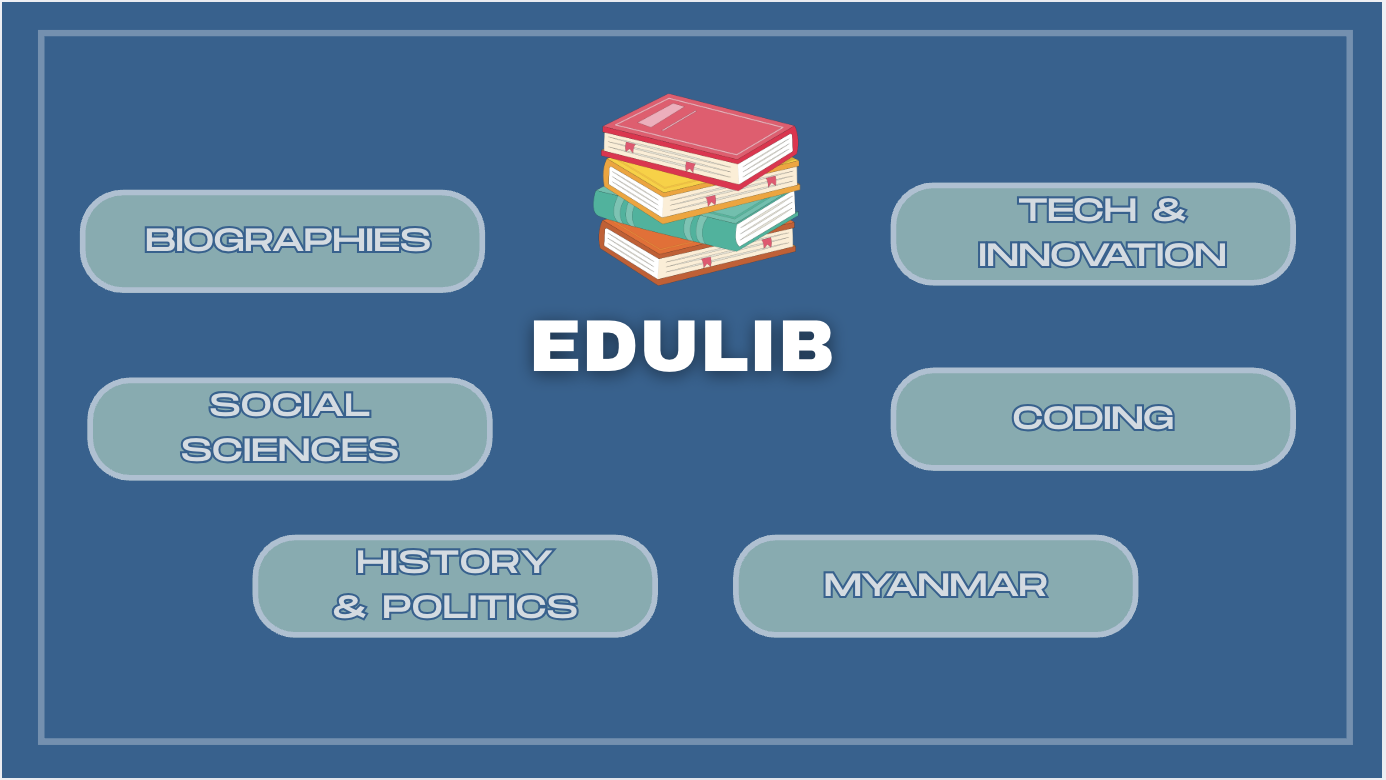
Explore a curated collection of the best educational books on social sciences, political theory, global history, artificial intelligence, coding, and technology. EduLib is designed to empower students, future leaders, and curious minds with real-world knowledge and critical thinking skills. Dive into specialized resources on Myanmar’s history and development to connect global perspectives with local identity.
Best Educational Books For Student Life
EduPlanet’s library offers curated books in social science, technology, AI, and Myanmar studies to support academic growth. It helps students deepen subject knowledge, explore global ideas, and connect learning to real-world contexts—making research easier and study more effective.
Social Sciences & Global Thinking

Explore how societies function, change, and connect through time. This category includes books on human behavior, culture, economics, and the global forces shaping our world. Perfect for building critical thinking and understanding real-world issues beyond the classroom.
Sapiens: A Brief History of Humankind | Yuval Noah Harari
🔹 Summary
Sapiens explores the sweeping history of Homo sapiens, from a minor species of ape to the dominant force on Earth. Harari structures this journey through three major revolutions:
- The Cognitive Revolution (~70,000 years ago) enabled abstract thought and collective myths.
- The Agricultural Revolution (~10,000 years ago) led to food surpluses and social hierarchies but also created suffering.
- The Scientific Revolution (starting ~500 years ago) sparked modern economies, empires, and technologies.
Harari argues that much of human success relies on our ability to believe in shared stories — from religion to capitalism — and he questions whether this “progress” has made individuals happier or freer.
🔹 Main Concepts and Theories
- Cognitive Revolution
- Sparked language and storytelling, allowing large-scale cooperation.
- Example: Belief in nations, religions, and legal systems.
- Sparked language and storytelling, allowing large-scale cooperation.
- Agricultural Revolution
- Created stability but led to overwork, inequality, and disease.
- Example: Farmers were less healthy than foragers.
- Created stability but led to overwork, inequality, and disease.
- Shared Myths / Imagined Orders
- Concepts like money, law, and corporations are fictional yet vital.
- Example: USD or Apple Inc. exist only because people believe they do.
- Concepts like money, law, and corporations are fictional yet vital.
- Scientific Revolution
- Progress became a central value, leading to capitalism and empire.
- Example: European colonialism linked with scientific expeditions.
- Progress became a central value, leading to capitalism and empire.
- Further Reading:
- Guns, Germs, and Steel by Jared Diamond
- Imagined Communities by Benedict Anderson
- Guns, Germs, and Steel by Jared Diamond
🔹 Quotes
“You could never convince a monkey to give you a banana by promising him limitless bananas after death in monkey heaven.”
“We did not domesticate wheat. It domesticated us.”
🔹 Implications for Society & Students
- Myanmar: Challenges the roles of monarchy, religion, and nationalism by showing how these are human-made myths.
- Asia: Encourages reflection on how traditions and modernization coexist.
- Global: Promotes a mindset of questioning, interdisciplinarity, and ethical reflection on history.
- For Students: Sparks critical thinking, historical consciousness, and awareness of human psychology and cooperation.
Homo Deus: A Brief History of Tomorrow | Yuval Noah Harari
🔹 Summary
In Homo Deus, Harari speculates about humanity’s next chapter. Having tackled war, famine, and plague, humans now seek godlike powers — immortality, artificial happiness, and omniscience. But with AI, algorithms, and biotech on the rise, Harari warns of a future where Dataism replaces humanism, and consciousness may become irrelevant. The book explores whether intelligence without consciousness (like AI) will rule the world, and whether humans can handle the consequences of their ambition.
🔹 Main Concepts and Theories
- Humanism vs. Dataism
- Humanism values human feelings; Dataism values data flow.
- Example: Algorithms may predict your needs better than your instincts.
- Humanism values human feelings; Dataism values data flow.
- Rise of Techno-Religions
- Technology and science could birth new belief systems.
- Example: Faith in Silicon Valley’s innovations or transhumanism.
- Technology and science could birth new belief systems.
- Hacking Humans
- Through biometric tracking and AI, companies can manipulate choices.
- Example: Facebook tracking behavior to influence emotions.
- Through biometric tracking and AI, companies can manipulate choices.
- Post-Human Future
- What happens when AI becomes more intelligent than humans?
- Example: Autonomous weapons or emotionless decision-making.
- What happens when AI becomes more intelligent than humans?
- Further Reading:
- The Singularity is Near by Ray Kurzweil
- Surveillance Capitalism by Shoshana Zuboff
- The Singularity is Near by Ray Kurzweil
🔹 Quotes
“History began when humans invented gods, and will end when humans become gods.”
“The most important question in 21st-century economics may well be: What should we do with all the superfluous people?”
🔹 Implications for Society & Students
- Myanmar: Raises concerns about being left behind in the AI race, and the dangers of foreign data control.
- Asia: Encourages tech literacy combined with ethical governance.
- Global: Warns of algorithmic control, urges reflection on the definition of humanity.
For Students: Builds awareness of AI ethics, privacy, and the power of human consciousness versus artificial intelligence.
Factfulness: Ten Reasons We’re Wrong About the World – and Why Things Are Better Than You Think | Hans Rosling
🔹 Summary
Factfulness challenges the myth that the world is getting worse. Hans Rosling, a Swedish doctor and data guru, uses global statistics to show that poverty, health, literacy, and gender equality have all improved dramatically in recent decades. He explains why people are still pessimistic due to cognitive biases, media sensationalism, and outdated worldviews and offers a calm, fact-based perspective on global development.
🔹 Main Concepts and Theories
- Gap Instinct
- We wrongly assume a binary world (rich vs. poor), ignoring the large middle.
- Example: Most people live in middle-income countries, not extreme poverty.
- Negativity Instinct
- We overestimate bad news and ignore progress.
- Example: Child mortality has halved in the last 20 years, but few know it.
- Single-Perspective Instinct
- Relying on one worldview or discipline skews understanding.
- Further Study: Max Roser’s Our World in Data project
🔹 Quotes
The world can be both bad and better.”
“Things are improving, and it’s not a matter of opinion—it’s a matter of fact.
🔹 Implications for Society & Students
For Students: Builds optimism grounded in fact, and sharpens skills in media analysis, statistics, and development studies.
Myanmar: Reframes development not as hopeless, but as steadily improving, encouraging participation in progress.
Asia: Counters media pessimism with statistical truth, fostering a more balanced worldview.
Global: Vital for policymakers, journalists, and educators to make decisions based on data.
21 Lessons for the 21st Century | Yuval Noah Harari
🔹 Summary
In 21 Lessons, Harari tackles the most urgent questions facing humanity today: the future of work, the rise of AI, nationalism, fake news, freedom, immigration, and secularism. Unlike his earlier books (Sapiens and Homo Deus), this one focuses not on the past or distant future, but the present. It’s structured as 21 thematic essays, each encouraging critical thinking about ethics, education, and survival in a rapidly changing world.
🔹 Main Concepts and Theories
- Artificial Intelligence & Automation
- Jobs will vanish and new ones will emerge, but most people aren’t being retrained.
- Example: Truck drivers being replaced by self-driving vehicles.
- Post-Truth & Misinformation
- Narratives matter more than facts; algorithms can spread falsehoods faster than truth.
- Example: Fake news in elections.
- Global Cooperation vs. Nationalism
- No nation alone can tackle climate change, pandemics, or cyber threats.
- Lifelong Learning
- Education must shift from memorization to critical thinking and adaptability.
- Further Study: Klaus Schwab’s The Fourth Industrial Revolution
🔹 Quotes
In a world deluged by irrelevant information, clarity is power.”
“If you want to keep your freedom, you need to know the truth.
🔹 Implications for Society & Students
For Students: Builds intellectual flexibility, critical thinking, and responsibility in a chaotic world.
Myanmar: Encourages reform in education, media literacy, and digital adaptation.
Asia: Warns about blind nationalism and lack of tech preparedness.
Global: Pushes for ethical AI development and cross-border cooperation.
History & Politics

From revolutions and empires to modern governments and ideologies, this section unpacks the events and ideas that shaped our world. Learn how power works, how nations rise and fall, and how individuals shape history. These books prepare students to think critically about leadership, justice, and change.
Why Nations Fail: The Origins of Power, Prosperity, and Poverty | Daron Acemoglu & James A. Robinson
🔹 Summary
This groundbreaking book explores why some nations become rich while others remain poor. Acemoglu and Robinson argue that the root cause of prosperity lies not in geography, culture, or ignorance, but in institutions. Nations with inclusive institutions (that distribute power broadly and encourage innovation) tend to prosper. In contrast, extractive institutions (which concentrate power and wealth in the hands of elites) create poverty. Through global case studies, from the U.S. to Zimbabwe, the book shows that economic development is political in nature.
🔹 Main Concepts and Theories
- Inclusive Institutions
- Encourage participation, property rights, innovation, and education.
- Example: The U.S. patent system and representative government.
- Encourage participation, property rights, innovation, and education.
- Extractive Institutions
- Controlled by elites; limit growth, exploit labor, and suppress opposition.
- Example: Colonial Latin America’s encomienda system; North Korea today.
- Controlled by elites; limit growth, exploit labor, and suppress opposition.
- Critical Junctures
- Historical moments that reshape institutions (e.g., Glorious Revolution in Britain).
- Historical moments that reshape institutions (e.g., Glorious Revolution in Britain).
- Feedback Loop
- Good institutions reinforce innovation and freedom; bad ones reinforce exploitation.
- Good institutions reinforce innovation and freedom; bad ones reinforce exploitation.
- Further Study:
- The Narrow Corridor by Acemoglu & Robinson
- Douglas North’s theory on institutional economics
- The Narrow Corridor by Acemoglu & Robinson
🔹 Quotes
“Nations fail today because their extractive economic institutions do not create the incentives needed for people to save, invest, and innovate.”
“Political institutions determine what economic institutions a country has.”
🔹 Implications for Society & Students
- Myanmar: Provides a strong framework to understand why democracy and economic reform must go together. Offers insight into the failures of military rule and corruption.
- Asia: Contrasts inclusive models (e.g., South Korea, Singapore) with extractive ones (e.g., pre-reform Myanmar or feudal systems).
- Global: A must-read for understanding development, aid effectiveness, and reform.
For Students: Builds political awareness, economic literacy, and a deep understanding of how to reform a broken system.
The Power of Geography: Ten Maps That Reveal the Future of Our World | Tim Marshall
🔹 Summary
A sequel to Prisoners of Geography, this book looks at 10 regions — including Australia, the Sahel, Turkey, the UK, Iran, and space — and explains how geography shapes global power and future conflict. Marshall blends geopolitics, history, and strategy to show how terrain, climate, borders, and resources drive national interest. The book suggests that even in an age of globalization and AI, physical geography still determines political decisions and international tensions.
🔹 Main Concepts and Theories
- Geopolitical Determinism
- Geography constrains and directs national behavior.
- Example: Iran’s mountains protect it; Turkey’s Bosphorus controls trade.
- Geography constrains and directs national behavior.
- Climate + Resource Pressure
- Climate change and resource scarcity will create new conflicts.
- Example: Sahel region facing desertification, radicalization, and migration.
- Climate change and resource scarcity will create new conflicts.
- Strategic Chokepoints
- Control over sea routes or borders translates into global power.
- Example: UK’s role in Atlantic trade or Australia in the Indo-Pacific.
- Control over sea routes or borders translates into global power.
- New Geographies: Space and the Arctic
- Outer space and melting Arctic will become geopolitical frontiers.
- Outer space and melting Arctic will become geopolitical frontiers.
- Further Study:
- Robert Kaplan’s The Revenge of Geography
- Nicholas Spykman’s Rimland Theory
- Robert Kaplan’s The Revenge of Geography
🔹 Quotes
“Geography is the stage on which the drama of human history is played.”
“Borders may change, but mountains, rivers, and seas do not.”
🔹 Implications for Society & Students
For Students: Excellent for those interested in IR, geography, or global strategy. It shows how physical land shapes diplomacy and conflict.
Myanmar: Helps students understand Myanmar’s strategic location between India, China, and Southeast Asia and its potential as a logistics and energy corridor.
Asia: Teaches how China’s BRI, India’s Act East policy, and Indo-Pacific competition affect each nation’s destiny.
Global: Reinforces the idea that geopolitics is not outdated — it’s being reshaped by climate, tech, and migration.
The Dictator’s Handbook: Why Bad Behavior is Almost Always Good Politics | Bruce Bueno de Mesquita & Alastair Smith
🔹 Summary
This provocative book explains why dictators and many democratic leaders act in ways that seem unethical or cruel. The authors argue that all leaders, good or bad, are ultimately focused on staying in power. They introduce the selectorate theory, which states that leaders prioritize the small group that keeps them in power (the winning coalition) rather than the general population. This creates incentives for corruption, repression, and resource control. The book is not about morality but rather about political logic.
🔹 Main Concepts and Theories
- Selectorate Theory
- Every political system has three groups: the nominal selectorate (everyone who can influence power), the real selectorate (those who actually influence it), and the winning coalition (those needed to stay in power).
- Example: In a dictatorship, the winning coalition may be just military generals.
- Rule of Survival
- Leaders prioritize their supporters — not the public — to stay in power.
- Example: Autocrats provide patronage instead of public services.
- Bad Policy, Good Politics
- Corruption, censorship, and oppression often help leaders stay in control.
- Further Study: Mancur Olson’s The Logic of Collective Action; Acemoglu & Robinson’s Why Nations Fail
🔹 Quotes
The world is unfair, and leaders do what they must to stay in power.”
“If a leader can steal and survive, why build schools?
🔹 Implications for Society & Students
For Students: Great for civics, IR, and political science as it explains how power works, not just how it should.
Myanmar: Gives students a realist lens to understand military rule, kleptocracy, and why reforms fail without structural change.
Asia: Highlights political behavior in countries with elite capture or flawed democracies.
Global: Equips future leaders to see through populist promises and focus on institutions.
The Origins of Political Order: From Prehuman Times to the French Revolution | Francis Fukuyama
🔹 Summary
Fukuyama traces the evolution of political institutions about how human societies went from tribalism to states with bureaucracy, rule of law, and accountability. The book argues that three pillars define good governance: the state, rule of law, and accountability. He explains how different civilizations developed these elements in unique ways. By comparing China, India, the Middle East, and Europe, Fukuyama explores why political order emerged successfully in some places but stagnated in others.
🔹 Main Concepts and Theories
- Three Pillars of Political Order
- The State: Centralized authority with enforcement capacity.
- Rule of Law: Law applies to rulers as well as the ruled.
- Accountability: Leaders answer to the people or institutions.
- Path Dependency
- History and institutions lock societies into certain paths.
- Example: China built a strong state early but lacked legal accountability.
- Political Decay
- Institutions can weaken over time if not updated.
- Further Study: Political Order and Political Decay (Fukuyama’s sequel), Weber’s theory of bureaucracy
🔹 Quotes
All political systems are built on the tension between power and legitimacy.”
“The problem is not getting to Denmark; it’s knowing how Denmark became Denmark.
🔹 Implications for Society & Students
For Students: Builds deep political literacy, connects history with modern civics, and encourages systemic thinking.
Myanmar: Offers tools to analyze why modern institutions struggle and how a state might be rebuilt through justice and accountability.
Asia: Explains differences in political development across China, India, and Islamic states.
Global: Essential for reformers, historians, and future leaders trying to understand how strong, fair institutions emerge.
Technology, AI, and Innovation

This category dives into the future—exploring artificial intelligence, big data, robotics, and the thinkers driving global innovation. Understand how technology shapes society, economies, and even ethics. Ideal for students curious about the digital world and where it’s taking us.
The Age of AI: And Our Human Future | Henry Kissinger, Eric Schmidt, Daniel Huttenlocher
🔹 Summary
In The Age of AI, Kissinger (former U.S. Secretary of State), Schmidt (former Google CEO), and Huttenlocher explore how artificial intelligence is reshaping knowledge, power, and identity. They discuss how AI’s rise not only changes industries but also alters how humans think and interact. Drawing from diplomacy, military, business, and philosophy, the book warns that AI will challenge traditional political structures and human understanding and that we must act now to ensure AI serves human ends.
🔹 Main Concepts and Theories
- AI as an Epistemological Disruption
- AI changes how we define truth and meaning.
- Example: AI language models can “create” knowledge that isn’t verified or understood.
- AI changes how we define truth and meaning.
- AI in Foreign Policy & War
- Autonomous weapons and surveillance could destabilize global security.
- Example: AI drones making decisions without human input.
- Autonomous weapons and surveillance could destabilize global security.
- Human-AI Collaboration vs. Control
- The real challenge is not if AI can think, but if we understand how it thinks.
- Example: DeepMind’s AlphaGo made “alien” moves that even grandmasters couldn’t interpret.
- The real challenge is not if AI can think, but if we understand how it thinks.
- Further Study:
- Life 3.0 by Max Tegmark
- AI Superpowers by Kai-Fu Lee
- Life 3.0 by Max Tegmark
🔹 Quotes
“AI’s gift is not only to augment human thinking, but to challenge it.”
“We are entering a world where human purpose and machine logic must be aligned or clash.”
🔹 Implications for Society & Students
For Students: Equips learners to be ethical innovators, policymakers, or AI developers who understand philosophy and policy, not just code.
Myanmar: Crucial for navigating future governance, education, and data sovereignty in a digitizing world.
Asia: Asian countries are both leaders and testbeds for AI (e.g., China’s surveillance tech; India’s AI for education).
Global: Encourages diplomacy, ethics, and cross-border regulation of powerful technologies.
Chip War: The Fight for the World’s Most Critical Technology | Chris Miller
🔹 Summary
Chip War uncovers the hidden history of how microchips, the tiny silicon brains inside every digital device, came to dominate global power struggles. From Cold War-era innovations to the modern U.S.–China tech rivalry, Chris Miller explores how semiconductors became the backbone of military power, economic growth, and geopolitical dominance. The book explains why control over chip design, manufacturing, and supply chains determines who leads the 21st century and warns of the vulnerability created by relying on a few countries like Taiwan and South Korea.
🔹 Main Concepts and Theories
- Semiconductors = Geopolitical Power
- Nations controlling chip innovation and production wield economic and military dominance.
- Example: U.S. military relies on advanced chips for missiles, drones, etc.
- Nations controlling chip innovation and production wield economic and military dominance.
- Global Supply Chain Vulnerability
- Chip production depends on an intricate, fragile chain (e.g., TSMC in Taiwan, ASML in Netherlands).
- Example: COVID-19 showed how car companies halted production due to chip shortages.
- Chip production depends on an intricate, fragile chain (e.g., TSMC in Taiwan, ASML in Netherlands).
- U.S.-China Tech Rivalry
- China is investing billions to build chip independence, while the U.S. tries to restrict access to advanced chips.
- Further Study: U.S. CHIPS Act (2022), China’s “Made in China 2025” strategy.
- China is investing billions to build chip independence, while the U.S. tries to restrict access to advanced chips.
- Silicon Monopolies
- ASML controls extreme ultraviolet (EUV) machines; TSMC leads in fabrication.
- Example: No one can make 3nm chips without Dutch or Taiwanese support.
- ASML controls extreme ultraviolet (EUV) machines; TSMC leads in fabrication.
🔹 Quotes
“The world’s most advanced machines — and the future of the global economy — depend on a few tiny pieces of silicon.”
“Control over chips equals control over the future.”
🔹 Implications for Society & Students
- Myanmar: Emphasizes the need to invest in STEM and local electronics knowledge instead of relying solely on imports.
- Asia: Highlights the rise of countries like Taiwan and South Korea as tech leaders and strategic targets.
- Global: Urges policy, education, and security alignment around semiconductor innovation.
For Students: Inspires careers in electrical engineering, hardware design, and geopolitics; crucial for students interested in building national tech resilience.
How to Create a Mind: The Secret of Human Thought Revealed | Ray Kurzweil
🔹 Summary
In How to Create a Mind, futurist and AI pioneer Ray Kurzweil explains how the human brain processes information and how this understanding can be used to build intelligent machines. He argues that the neocortex functions as a pattern recognizer and that by mimicking it, we can build conscious machines. Kurzweil blends neuroscience, computer science, and philosophy to explore the future of artificial intelligence and consciousness.
🔹 Main Concepts and Theories
- Pattern Recognition Theory of Mind (PRTM)
- The brain is a hierarchy of pattern recognizers; AI can be built the same way.
- Example: Language models learning grammar by identifying usage patterns.
- Reverse Engineering the Brain
- Kurzweil believes AI will surpass human intelligence by mimicking neural architecture.
- Example: Deep learning models as early steps.
- Singularity Hypothesis
- By ~2045, AI will reach superintelligence, radically transforming life.
- Further Study: The Singularity is Near by Kurzweil; On Intelligence by Jeff Hawkins
- Ethics and Consciousness
- Raises questions about free will, human uniqueness, and machine rights.
🔹 Quotes
The brain is a pattern-recognition machine, and so are the machines we are now building.”
“We are not a logical species, we are a pattern-recognizing species.
🔹 Implications for Society & Students
For Students: Ideal for those fascinated by consciousness, robotics, neuroscience, and the future of education and employment.
Myanmar: Encourages entry into neuroscience, AI, and brain-computer interface fields and not just basic coding.
Asia: Relevance to rapidly growing AI research hubs in Singapore, India, China, and Japan.
Global: Raises philosophical and ethical questions about the role of humans in a post-AI era.
The Innovators: How a Group of Hackers, Geniuses, and Geeks Created the Digital Revolution | Walter Isaacson
🔹 Summary
The Innovators is a sweeping narrative of the people behind the digital revolution from Ada Lovelace and Alan Turing to Steve Jobs and Bill Gates. Isaacson tells the story of how computers, the internet, and software were not invented by lone geniuses, but by collaborative networks of scientists, engineers, entrepreneurs, and visionaries. The book emphasizes how human creativity and teamwork gave rise to one of the most transformative eras in history.
🔹 Main Concepts and Theories
- Collaborative Innovation
- Major breakthroughs in tech were built upon the work of many, not isolated individuals.
- Example: The internet emerged from U.S. military projects and university networks, not just Silicon Valley.
- Interdisciplinary Genius
- Innovation often arises when art meets science.
- Example: Steve Jobs combined aesthetic design with technical skill.
- Women in Computing
- Ada Lovelace, Grace Hopper, and others were pioneers, but often written out of mainstream history.
- From Hardware to Software to Networks
- The shift from machines (ENIAC) to code (software) to platforms (internet).
- Further Study: Isaacson’s Steve Jobs biography; Code by Charles Petzold
🔹 Quotes
Creativity is a collaborative process. Innovation comes from teams more than from the lightbulb moment.”
“Ada Lovelace was the prophet of the computer age.
🔹 Implications for Society & Students
For Students: Inspires curiosity and teamwork. Useful for tech, entrepreneurship, and design-minded students.
Myanmar: Encourages students to pursue coding, teamwork, and startups not just wait for government reform.
Asia: Affirms the importance of STEAM (Science + Art) education in nurturing innovation.
Global: Supports inclusive innovation narratives — highlighting underrepresented voices.
Coding & Computer Science

Get hands-on with the logic and language of the modern world. Whether you’re starting with Scratch or diving into Python, this section provides books that teach code, algorithms, and problem-solving. It’s a launchpad for future programmers, app builders, and digital creators.
Hello World: Being Human in the Age of Algorithms | Hannah Fry
🔹 Summary
In Hello World, mathematician Hannah Fry explores how algorithms are increasingly shaping our decisions, from dating apps to sentencing in courts, from healthcare to hiring. Through engaging stories, she shows both the promise and dangers of algorithmic systems, especially when they replace human judgment. Fry stresses the importance of transparency, fairness, and understanding the limits of machine intelligence in a world where even life-changing decisions are increasingly “outsourced” to machines.
🔹 Main Concepts and Theories
- Algorithmic Bias
- Algorithms reflect the data we feed them, which often carries societal bias.
- Example: Facial recognition performing worse on darker-skinned individuals.
- Algorithms reflect the data we feed them, which often carries societal bias.
- Black Box Problem
- Many algorithms, like deep learning models, are not explainable, even by their creators.
- Example: Credit scoring systems that cannot explain rejections.
- Many algorithms, like deep learning models, are not explainable, even by their creators.
- Human + Machine Collaboration
- The best results often come from combining human judgment and algorithmic speed.
- Further Study: Cathy O’Neil’s Weapons of Math Destruction; Timnit Gebru’s work on AI ethics
- The best results often come from combining human judgment and algorithmic speed.
- Ethical Design
- We must design algorithms with transparency, accountability, and context.
- We must design algorithms with transparency, accountability, and context.
🔹 Quotes
“The real danger isn’t that computers will start to think like humans, but that humans will start to think like computers.”
“Algorithms don’t make things fair. They only make things faster.”
🔹 Implications for Society & Students
For Students: Empowers future engineers, policymakers, and tech users to question, audit, and improve algorithmic systems before blindly trusting them.
Myanmar: Highlights the need for digital fairness in developing societies where AI could be adopted without public understanding.
Asia: Applies directly to countries experimenting with mass automation, fintech, and e-governance.
Global: Pushes for algorithmic transparency, ethics, and digital rights movements.
Code: The Hidden Language of Computer Hardware and Software | Charles Petzold
🔹 Summary
Code is a journey through the history and logic of how computers work ,starting from the simplest ideas like Morse code and Braille, and progressing all the way to transistors, binary, logic gates, and operating systems. Petzold explains how everyday concepts such as switches and circuits form the foundation of digital computing. It’s about understanding how computers think at the most fundamental level.
🔹 Main Concepts and Theories
- Binary and Logic
- All data in computers is stored and processed in binary (0s and 1s).
- Example: Letters and numbers are encoded using ASCII or Unicode.
- All data in computers is stored and processed in binary (0s and 1s).
- Switches to Logic Gates
- Switches control electricity; combined, they form logic gates (AND, OR, NOT).
- Example: A calculator’s decision-making is based on gates.
- Switches control electricity; combined, they form logic gates (AND, OR, NOT).
- Building from the Ground Up
- The book explains how a physical circuit can eventually represent a simple computer.
- Related Concept: Turing Machines.
- The book explains how a physical circuit can eventually represent a simple computer.
- Abstraction Layers
- Hardware → Assembly → Operating System → Applications
- Further Study: The Elements of Computing Systems by Nisan & Schocken
- Hardware → Assembly → Operating System → Applications
🔹 Quotes
“What do flashlights, the British invasion, black cats, and seesaws have to do with computers? Everything.”
“Inside the computer, everything is just a pattern of on and off signals — but with enough complexity, it becomes thought.”
🔹 Implications for Society & Students
- Myanmar: Gives a clear, foundational understanding of how digital tools actually work, making it ideal for building tech literacy and hardware skills locally.
- Asia: Encourages hardware innovation and education, especially in low-tech regions.
- Global: Fosters a generation that understands not just how to code, but what code is built upon.
For Students: Perfect for aspiring engineers, inventors, and curious thinkers. Makes computers less mysterious, more logical, and more buildable from scratch.
Python Crash Course: A Hands-On, Project-Based Introduction to Programming | Eric Matthes
🔹 Summary
Python Crash Course is a fast-paced, comprehensive introduction to Python programming for beginners. It starts with core concepts such as variables, loops, functions, classes and then shifts to exciting projects like games, data visualization, and web apps. Designed for self-learners, the book balances theory and application, helping readers think like programmers while working on real code.
🔹 Main Concepts and Theories
- Python Fundamentals
- Syntax, control flow, error handling, classes and objects.
- Project-Based Learning
- Three major projects: a 2D game with
pygame, data graphs withmatplotlib, and a Django web app.
- Three major projects: a 2D game with
- Best Practices
- Encourages clean code, modular design, and debugging skills.
- Example: Using Git and terminal commands for real workflows.
- Further Study:
- Combine with Automate the Boring Stuff or CS50’s Python track for advanced skills.
🔹 Quotes
The best way to learn programming is by doing — and making mistakes.”
“With Python, you can bring your ideas to life quickly.
🔹 Implications for Society & Students
For Students: Excellent foundation for future work in software, STEM, AI, or entrepreneurship. Also ideal for club projects and self-led innovation.
Myanmar: A practical gateway into tech careers, from freelance work to data analysis.
Asia: A tool for building the digital literacy pipeline needed in every sector.
Global: Empowers the next generation of developers and problem-solvers.
Automate the Boring Stuff with Python: Practical Programming for Total Beginners | Al Sweigart
🔹 Summary
This hands-on guide teaches beginners how to use Python to automate everyday computer tasks. Instead of focusing on abstract theory, Sweigart shows how to write scripts that solve real-world problems — such as renaming files, sending emails, scraping websites, or filling out forms. The book is perfect for learners who want immediate utility from programming, and it builds skills through projects and step-by-step examples.
🔹 Main Concepts and Theories
- Practical Python Basics
- Covers variables, loops, functions, strings, lists, and dictionaries.
- Automation Scripts
- Example: A program that renames files in bulk or downloads online images automatically.
- Web Scraping and GUI Automation
- Teaches how to extract content from websites or control your mouse and keyboard through code.
- Example: Using
pyautoguito move your mouse, take screenshots, or automate data entry.
- Best for Beginners
- Doesn’t assume prior knowledge; explains everything simply.
- Further Study: Python Crash Course or CS50’s Intro to Programming
🔹 Quotes
You don’t need to be a software engineer to automate boring stuff.”
“Writing a program is like giving a friend step-by-step instructions on how to make toast.
🔹 Implications for Society & Students
For Students: A confidence-builder. Shows how coding solves everyday problems and inspires real-world application.
Myanmar: Ideal for students and office workers who want to boost productivity with free, open-source tools.
Asia: Supports digital upskilling in schools, NGOs, and businesses.
Global: Democratizes coding by making it useful and accessible to non-tech professionals.
All About Myanmar

Rooted in regional relevance, this section highlights Myanmar’s complex history, culture, politics, and its place in Southeast Asia. Explore colonial legacies, ethnic identities, and current affairs through local and international voices. A must-read category for students who want to understand their roots and role in the world.
Where China Meets India: Burma and the New Crossroads of Asia | Thant Myint-U
🔹 Summary
In this earlier book, Thant Myint-U traces Myanmar’s strategic geography and how it connects China, India, and Southeast Asia. Through travel, interviews, and historical narrative, he shows how Myanmar’s roads, rivers, and ethnic frontiers are being transformed by the economic rise of its two giant neighbors. He explores China’s infrastructure push in northern Myanmar, India’s limited influence, and the deep cultural ties across borders, revealing that Myanmar is not peripheral, but central to Asia’s future.
🔹 Main Concepts and Theories
- Geostrategic Crossroads
- Myanmar is the only land bridge between India and China , a fact shaping its economy, diplomacy, and conflict.
- Example: Gas pipelines and roads from Yunnan to the Bay of Bengal.
- Myanmar is the only land bridge between India and China , a fact shaping its economy, diplomacy, and conflict.
- Borderland Economies and Ethnic Politics
- Border areas have different rules, loyalties, and economic realities.
- Example: Wa State acting like a Chinese satellite; cross-border trade in drugs and jade.
- Border areas have different rules, loyalties, and economic realities.
- China’s “Go West” Strategy
- China uses Myanmar to access the Indian Ocean and bypass Malacca Strait.
- Example: Kyaukphyu port and China–Myanmar Economic Corridor.
- China uses Myanmar to access the Indian Ocean and bypass Malacca Strait.
- India’s Hesitancy
- India’s limited engagement has left it lagging in influence.
- Further Study: Belt and Road Initiative, Act East Policy
- India’s limited engagement has left it lagging in influence.
🔹 Quotes
“If Burma can get its act together, it will become one of the most strategic and richest places in Asia.”
“At the crossroads of India and China, the future of Asia may well be decided.”
🔹 Implications for Society & Students
- Myanmar: Empowers students to rethink their nation’s identity not as isolated, but as a potential hub. Calls for building roads, education, and policy that bridge worlds.
- Asia: Explains Myanmar’s place in the China–India rivalry and the broader Indo-Pacific.
- Global: Highlights the role of geography and local actors in the new Great Game of infrastructure and influence.
For Students: Vital for those interested in regional politics, economics, or diplomacy, especially how local choices matter in global competition.
Burmese Days | George Orwell
🔹 Summary
Set in 1920s colonial Burma (now Myanmar), Burmese Days tells the story of John Flory, a disillusioned British timber merchant living in the fictional town of Kyauktada. Trapped between two worlds, Flory despises the racism and arrogance of the British ruling class but lacks the courage to challenge it openly. As he falls in love with Elizabeth Lackersteen, a young Englishwoman, his hopes for redemption falter under the oppressive social norms of imperialism. The novel critiques the corrupt, decaying nature of the British Empire and the moral compromise required to survive within it. It ends tragically, symbolizing the personal and systemic failures of colonialism.
🔹 Main Concepts and Theories
- Colonialism and Moral Decay
- The novel exposes the cruelty, hypocrisy, and corruption embedded in the British imperial system.
- Example: The European Club in the novel denies native membership, symbolizing exclusion and racism.
- The novel exposes the cruelty, hypocrisy, and corruption embedded in the British imperial system.
- Internalized Racism and Cowardice
- Flory is aware of the injustice but remains passive, revealing the psychological toll of complicity.
- Related Study: Franz Fanon’s The Wretched of the Earth explores the mental effects of colonization.
- Flory is aware of the injustice but remains passive, revealing the psychological toll of complicity.
- Imperial Isolation and Identity Crisis
- The British characters, especially Flory, feel emotionally and culturally detached from both the Burmese and their fellow Europeans.
- Example: Flory’s failure to connect with Elizabeth or the Burmese represents a fractured identity.
- The British characters, especially Flory, feel emotionally and culturally detached from both the Burmese and their fellow Europeans.
- False Romance of Empire
- Orwell dismantles the romanticized view of empire by showing its dullness, cruelty, and human cost.
- Further Reading: E.M. Forster’s A Passage to India, Joseph Conrad’s Heart of Darkness
- Orwell dismantles the romanticized view of empire by showing its dullness, cruelty, and human cost.
🔹 Quotes
“The lie that we’re here to uplift the natives, when we’re only here to fleece them.”
“He had been comprehensively corrupted by the Empire, and knew it, and hated it.”
🔹 Implications for Society & Students
- Myanmar: Offers a vital mirror into how the country was viewed and managed under British rule. Helps students reflect on colonial trauma, cultural loss, and national identity.
- Asia: A warning against foreign domination and the long-lasting effects of internalized oppression.
- Global: Sheds light on how colonial systems breed both resistance and moral collapse, making it a key text in colonial literature.
For Students: Useful for history, literature, and civics education. Builds critical thinking about power, race, and identity. Encourages students to reflect on the legacies still visible in Myanmar’s political and social structures.
Biographies

Learn from the lives of changemakers, scientists, activists, and leaders across time and continents. These personal stories bring history and innovation to life while inspiring students to reflect on their own journey. Biographies build empathy, courage, and curiosity—one life at a time. Check out https://www.goodreads.com for more books!
The Sky is Not the Limit: Adventures of an Urban Astrophysicist | Neil deGrasse Tyson
🔹 Summary
In this memoir-meets-essay collection, renowned astrophysicist Neil deGrasse Tyson shares his personal journey from a curious child in the Bronx to becoming one of the most recognizable science communicators in the world. The book weaves scientific explanation with social commentary, revealing how race, education, and opportunity shaped his path in the sciences. Tyson reflects on the wonders of the cosmos, the power of curiosity, and the human need to explore always with humor, honesty, and clarity.
🔹 Main Concepts and Theories
- Cosmic Perspective
- Science helps us understand our small place in the universe, which can be both humbling and empowering.
- Example: Earth is just one pale dot among billions, yet capable of understanding the cosmos.
- Science helps us understand our small place in the universe, which can be both humbling and empowering.
- Science Literacy and Equity
- Scientific curiosity must be nurtured in all communities, not just elite ones.
- Example: Tyson credits early mentorship, even while facing racism.
- Scientific curiosity must be nurtured in all communities, not just elite ones.
- Public Engagement in Science
- Scientists must speak in ways the public understands and cares about.
- Related Study: Carl Sagan’s legacy in science communication
- Scientists must speak in ways the public understands and cares about.
- Interplay of Race and Education
- Tyson faced barriers as a Black student entering elite science spaces, a reminder of ongoing inequality.
- Tyson faced barriers as a Black student entering elite science spaces, a reminder of ongoing inequality.
🔹 Quotes
“Knowing how to think empowers you far beyond those who only know what to think.”
“The universe is under no obligation to make sense to you.”
🔹 Implications for Society & Students
- Myanmar: Encourages students from all backgrounds to see science not as elitist, but as a tool for exploration and self-worth.
- Asia: Inspires future scientists to embrace curiosity and resilience even in underfunded systems.
- Global: Reinforces the need for diversity in STEM and science education reform.
For Students: Uplifting for students who doubt whether they “belong” in science; promotes confidence, inquiry, and purpose beyond textbooks.
Night and Works | Elie Wiesel
🔹 Summary
Night is a harrowing autobiographical account of Elie Wiesel’s experience as a teenage boy in Nazi concentration camps during the Holocaust. He chronicles his journey from innocence to unimaginable suffering, witnessing the death of his family, the loss of faith, and the moral collapse around him. Wiesel’s later works continue to advocate for memory, justice, and the moral responsibility to resist oppression and indifference. His life’s work became a voice for survivors and a warning for future generations.
🔹 Main Concepts and Theories
- Memory as Moral Responsibility
- Remembering the past is necessary to prevent future atrocities.
- Example: Holocaust denial and historical erasure are dangerous.
- Remembering the past is necessary to prevent future atrocities.
- Dehumanization and Silence
- Evil thrives not only through violence but through silence and complicity.
- Example: The passivity of the world during the Holocaust.
- Evil thrives not only through violence but through silence and complicity.
- Faith and Loss
- Wiesel’s belief in God is tested as he sees children hanged, innocents burned.
- Related Study: Viktor Frankl’s Man’s Search for Meaning; Primo Levi’s works
- Wiesel’s belief in God is tested as he sees children hanged, innocents burned.
- Witness Literature
- Wiesel pioneered post-Holocaust literature that insists on testimony and truth.
- Wiesel pioneered post-Holocaust literature that insists on testimony and truth.
🔹 Quotes
“To forget the dead would be akin to killing them a second time.”
“The opposite of love is not hate, it’s indifference.”
🔹 Implications for Society & Students
For Students: Essential for understanding the dangers of apathy, the value of human dignity, and how one voice, even one, can honor millions lost.
Myanmar: Resonates deeply in a country where ethnic cleansing and mass silence have happened. Teaches students the power of witnessing, speaking up, and resisting dehumanization.
Asia: Powerful reminder of how state violence and nationalism can spiral into genocide.
Global: Shapes our understanding of human rights, empathy, and historical memory.
The Diary of Anne Frank (also known as The Diary of a Young Girl)
🔹 Summary
This world-famous diary was written by Anne Frank, a Jewish teenager hiding from the Nazis in Amsterdam during World War II. Anne writes about daily life, fears, and hopes while confined in the Secret Annex for over two years. Her diary captures the horror of persecution and the resilience of the human spirit. Tragically, Anne died in a concentration camp — but her words continue to speak for millions silenced by war.
🔹 Main Concepts and Theories
- The Power of Personal Testimony
- Anne’s diary personalizes the Holocaust, giving voice to victims not as numbers, but as human beings.
- Hope Amid Horror
- Even in hiding and fear, Anne reflects on nature, love, and her dreams.
- Example: Her desire to become a writer.
- The Cost of Indifference and Hatred
- Shows what happens when racism and authoritarianism go unchecked.
- Further Study: Night by Elie Wiesel, Man’s Search for Meaning by Viktor Frankl
🔹 Quotes
In spite of everything, I still believe that people are really good at heart.”
“I can shake off everything as I write; my sorrows disappear, my courage is reborn.
🔹 Implications for Society & Students
For Students: Inspires courage, emotional depth, and the power of writing as a tool for truth and survival.
Myanmar: A reminder of the need to document injustice and uplift marginalized voices, which is relevant to ethnic and religious minorities.
Asia: Warns against authoritarianism and ethnic violence, promotes empathy.
Global: Humanizes the horrors of war and bigotry, often used in schools to teach tolerance.
Long Walk to Freedom | Nelson Mandela
🔹 Summary
This powerful autobiography chronicles Nelson Mandela’s life: from his rural Xhosa childhood, through his legal and political activism against apartheid, to his 27 years in prison and eventual rise as South Africa’s first Black president. Mandela reflects on the personal sacrifices made in the fight for racial equality and dignity. The book is a testimony to courage, forgiveness, and the belief that justice must triumph not through hatred, but through understanding and unity.
🔹 Main Concepts and Theories
- Liberation through Resistance
- Freedom isn’t granted because it must be demanded and earned through persistent struggle.
- Example: Mandela’s role in founding the ANC Youth League and leading armed resistance.
- Reconciliation over Revenge
- After years of oppression, Mandela chose national unity over revenge.
- Example: Truth and Reconciliation Commission and peaceful transition of power.
- Leadership through Sacrifice
- Moral leadership often means enduring hardship for future generations.
- Further Study: Desmond Tutu’s No Future Without Forgiveness; Martin Luther King Jr.’s Letter from Birmingham Jail
🔹 Quotes
I have walked that long road to freedom… but I can only rest for a moment, for with freedom comes responsibilities.”
“No one is born hating another person because of the color of his skin.
🔹 Implications for Society & Students
For Students: Empowers moral courage, teaches patience in activism, and shows that dignity and peace can prevail even after decades of pain.
Myanmar: A deeply relevant story about unjust imprisonment, resistance, and national healing speaks to students experiencing division or political oppression.
Asia: Teaches non-violence, democratic values, and inclusive leadership.
Global: A blueprint for peaceful resistance and political transformation.