
Global Affairs & Diplomacy
Explore global diplomacy to understand how countries interact, negotiate, and build alliances.
International Alliances in 2025: Diplomacy and Economics in a Fragmented World
Introduction
In 2025, the landscape of international alliances is both intricate and dynamic. As global power becomes increasingly multipolar, nations form alliances not just for defence but for trade, infrastructure and values. Some alliances are securing aggressive foreign policies; others prioritize economic growth or climate resilience. This article explores the evolution of key diplomatic and economic alliances, their strategic purposes, emergent blocs, and their implications for global stability.
1. Traditional Security Alliances
1.1 NATO and Transatlantic Ties
NATO remains central to collective defence, especially in light of prolonged support for Ukraine. In 2025, the U.S. announced plans for a unified NATO command in Europe, reinforcing continental military integration. However, internal divisions persist: EU members face pressure to increase defence spending, while the U.S. remains idiosyncratic under shifting political leadership. This paradox underscores NATO as both a critical shield and a site of transatlantic tension.
1.2 Weimar+ Bloc
In February 2025, a cooperative grouping known as Weimar+, expanding the historic Weimar Triangle, emerged. Now comprising France, Germany, Poland, the UK, Italy, Spain, and the European Commission, Weimar+ seeks a coordinated European presence in global diplomacy (especially regarding Ukraine). It reflects Europe’s ambition to exercise geopolitical influence independently of the U.S.
2. Economic and Trade Blocs
2.1 The Rise of BRICS+
BRICS (originally Brazil, Russia, India, China and South Africa) expanded to include Indonesia and Nigeria in early 2025. This coalition now represents over 40% of the world population and commands significant economic weight. BRICS+ promotes alternative financial institutions, de-dollarization, and South-South trade agreements, challenging Western-dominated global finance.
2.2 Eurasian Economic Union (EAEU) Partnerships
Russia’s EAEU continues to deepen trade ties with Asia. New agreements with China, Iran (activated May 2025), Vietnam, and Singapore highlight a shifting commercial landscape. These partnerships underscore the EAEU’s strategy to integrate with Asia-Pacific economies, bypassing Western-centric trade structures.
2.3 APEC and Trade Diplomacy
Asia-Pacific economic cooperation remains vital, particularly under trade diplomacy frameworks. Recent APEC envoys meetings emphasized revitalizing multilateral trade systems and confronting tariff-based fragmentation. As nations accommodate post-pandemic and geopolitical pressure, APEC serves as a platform for stability and economic harmonization.
3. Regional Security and Defense pacts
3.1 EU–Asia Security Partnerships
Europe is increasing its security footprint in Asia. A recent pact between the EU and Australia echoes similar agreements with Japan and South Korea. It covers cooperation on defence technologies, cyber resilience, and disinformation, which arekey components of modern security strategy in a contested Indo-Pacific.
3.2 ECOWAS and Sahel Alliances
In West Africa, ECOWAS confronts internal fractures. Meanwhile, the Alliance of Sahel States (Mali, Niger, Burkina Faso) has formed a military and economic bloc with ties to Russia and China, representing a state-led counter-mobilization against former colonial influence. This development underscores the fragmentation and militarization of African regional dynamics.
4. Diplomatic Coalitions and Soft Power
4.1 G7 and Strategic Coordination
The 2025 G7 summit in Canada brought together world leaders to address Middle East tensions, climate crises, and economic fragmentation. Canada, under Chair Mark Carney, bypassed a group communiqué to avoid U.S. discord. Instead, it orchestrated bilateral dialogues and partnerships that sustain functional cooperation amid unpredictable politics.
4.2 European Shifts and US Tensions
Europeans are distancing diplomatically from U.S. preeminence. In June 2025, British, German, and French foreign ministers met Iran’s envoy individually—demonstrating a pursuit of independent mediation roles. Concurrently, European Central Bank leadership highlighted U.S. policy as a driver of Eurasian economic realignment, warning that EU may fall victim to American strategies.
5. The Global South’s Rising Influence
Emerging alliances reflect deeper shifts in global power:
- Global South mobilization via the G77 and BRICS emphasizes equitable development, climate justice, and fiscal reform.
- South-South cooperation is on the rise: Asia, Africa, and Latin America share infrastructure, trade tech, and educational initiatives.
- Strategic diplomacy is shifting: China seeks EU partnership, Africa explores new development banks, and Southeast Asian nations integrate regionally while globalizing.
This represents the Global South moving from dependency to strategic influence.
6. Multilateral Tensions and Fragmentation
The post-1945 multilateral order shows strain:
- WTO and UN Security Council face gridlock over reforms and veto dynamics.
- New economic frameworks such as the BRICS+, EAEU deals can bypass legacy institutions.
- Regional alliances, from Sahel confederations to EU–Asia pacts, reflect atomized governance models.
While fragmentation raises conflict risks, it also suggests increased resilience through multiple dependency structures.
7. Economic Diplomacy as Strategic Tool
Economic levers are central to modern alliances:
- De-dollarization and trade currency swaps challenge U.S. financial dominance.
- Supply chain realignment ensures critical goods bypass geopolitical vulnerability.
- Green finance and sustainability alliances—part of broader trade diplomacy—shape long-term cooperation agendas.
Economic diplomacy now underpins alliance architecture, blending sustainability with strategic imperatives like diverging energy routes and AI cooperation.
Conclusion
In 2025, global alliances are defined less by ideology and more by pragmatism, crisis response, and economic self-interest. As power diffuses, coalitions adapt with some deepening militaries, others trading currencies or sharing digital infrastructure. The real story is the motive behind these partnerships.
Understanding these partnership, from NATO to BRICS+, Weimar+ to Sahel confederation is essential to predicting where global stability and cooperation might grow or fracture. That future depends upon whether alliances can maintain unity. And that balance, for better or worse, will shape this century.
Reference Links
- https://www.reuters.com/world/us/americas-next-top-general-europe-will-also-lead-nato-officials-say-2025-05-30/
- https://en.wikipedia.org/wiki/Weimar%2B
- https://en.wikipedia.org/wiki/BRICS
- https://en.wikipedia.org/wiki/Eurasian_Economic_Union
- https://www.reuters.com/world/asia-pacific/china-will-trade-with-more-friends-rather-than-throwing-punches-foreign-ministry-2025-04-15/
- https://www.reuters.com/world/china/us-china-reach-deal-slash-tariffs-officials-say-2025-05-12/
- https://asean.org/wp-content/uploads/2021/08/ASEAN-Digital-Masterplan-2025.pdf
- https://www.reuters.com/sustainability/climate-energy/jihadist-violence-coups-test-west-africa-ecowas-bloc-50-2025-05-28/
- https://www.theguardian.com/commentisfree/2025/jun/19/europe-us-middle-east-israel-gaza-iran
- https://www.reuters.com/world/china-ambassador-eu-partnership-us-abuse-2025-04-16/
- https://www.politico.com/news/2025/06/15/mark-carney-g7-alberta-trump-00406353
- https://apnews.com/article/b98aad10779d9af5456c1a6553ffe59b
- https://www.reuters.com/business/take-five/global-markets-themes-graphic-2025-02-14/
- https://behorizon.org/the-rising-importance-of-the-global-south-in-2025-a-new-pillar-of-multipolar-power/
How Treaties Work: The Paris Agreement & Geneva Conventions Explained
Introduction: Power Through Agreement
International treaties are legally binding agreements between states that regulate global behavior, address shared challenges, and protect rights. Treaties like the Paris Agreement and the Geneva Conventions shape climate action and warfare conduct, demonstrating how diplomacy can enforce collective norms, mobilize resources, and hold nations accountable.
I. The Paris Agreement (2015)
1. Purpose & Architecture
The Paris Agreement, adopted in 2015 under the UNFCCC, focuses on global climate action. Its goals are to limit warming “well below” 2°C above pre‑industrial levels and “pursue efforts to limit” warming to 1.5 °C. It created a system where countries set their own targets, known as Nationally Determined Contributions (NDCs) and report progress every five years (Global Stocktake).
This bottom-up model uses transparency and peer pressure rather than enforcement sanctions.
2. Core Mechanisms
- NDCs: Each country defines its own emission reductions or climate initiatives; updated every five years to increase ambition.
- Transparency Framework: Starting 2024, countries must report emissions, mitigation, adaptation, and support (capacity‑building or finance).
- Global Stocktake: Every five years, collective progress is assessed to guide future NDCs.
- Technology & Capacity-Building: The agreement promotes tech transfer and strengthens support for developing countries.
3. Legal Status & Ratification
The Paris Agreement is a treaty under international law. As of now, 195 parties have ratified it. The U.S. famously withdrew in 2025 under a new administration but remains one of only four non‑ratifiers.
4. Enforcement & Compliance
There are no formal penalties for missing NDCs. Instead, the system relies on norms, peer pressure, transparency, and reputation. However, built-in mechanisms like the Global Stocktake aim to ratchet ambition upward.
Countries can also voluntarily engage in carbon-credit markets (Article 6) to meet targets collaboratively.
5. Impact and Limitations
- Partial Success: Slowed projected warming (to ~2.7°C by 2100), but emissions remain above required paths .
- Finance Commitments: Developed nations pledged $100 billion annually until 2025; growing demands (now ~$300 billion) are still being negotiated.
- Gaps: NDCs and implementation don’t yet meet 1.5°C goals. Political will and funding remain major hurdles.
II. The Geneva Conventions (1949 + Protocols)
1. Origins & Purpose
Emerging from centuries of codified humanitarian norms, the Geneva Conventions (1949) are central to international humanitarian law. They set rules to limit war’s inhumanity by protecting non-combatants, the wounded, and prisoners .
2. The Four Conventions
- 1st Convention: Protects the wounded and sick in the field.
- 2nd: Extends protections to wounded at sea and hospital ships .
- 3rd: Establishes humane treatment standards for POWs .
- 4th: Protects civilians in war zones, forbidding collective punishment and targeting civilians.
Two Additional Protocols (1977) expanded protections to internal conflicts and modern warfare agents.
3. Participation & Authority
Practically every country (≈196 states) is a party to the Conventions. They are legally binding and supported by the International Committee of the Red Cross (ICRC). Institutions like the International Criminal Court (ICC) enforce violations by prosecuting war crimes.
4. Core Principles
- Distinction: Civilians must be differentiated from combatants.
- Proportionality: Incidental civilian harm must not exceed direct military advantage.
- Humane Treatment: Torture, degrading treatment, and hostage-taking are prohibited .
- Care & Repatriation: Wounded, sick, and POWs must receive care and humane treatment.
5. Enforcement
Violations, called “grave breaches”, must be prosecuted domestically or internationally . Despite obligatory action, prosecutions are rare. Despite that, compliance depends on domestic enforcement, war-crimes tribunals, and naming and shaming
6. Contemporary Relevance and Challenges
The conventions remain vital, even as modern warfare evolves. Critics note misuse or disregard, especially in Gaza or Ukraine yet the laws retain relevance because they provide a foundation for legal accountability and international norms.
III. Comparison: Two Different Treaty Models
| Feature | Paris Agreement | Geneva Conventions |
| Scope | Climate change action | Conduct in armed conflict |
| Basis | Bottom-up pledges (NDCs) | Universal legal obligations |
| Binding mechanisms | Reporting & peer pressure | Domestic prosecution + international bodies |
| Enforcement | Transparency, reputation | Criminal responsibility, tribunals |
| Update cycle | Every 5 years (stocktake, NDCs) | Fixed, though interpreted case-by-case |
| Violations | No formal penalties | “Grave breaches” mandate prosecution |
| Global participation | 195 parties | ~196 states |
IV. How Treaties Work in Practice
1. Negotiation & Signing
Governments negotiate texts, often over many years. Paris was agreed in 2015, open for signature in 2016. The Geneva Conventions emerged after WWII and codified centuries of humanitarian norms.
2. Ratification
States formally accept treaties via domestic processes. Entry into force may require a minimum number of ratifications (e.g., the Paris Agreement was binding once 55 states accounting for 55% of global emissions ratified).
3. National Implementation
Articles must be translated into domestic legislation. For Paris, this means climate laws; for Geneva, this means enshrining protections for civilians and POWs in military manuals and criminal codes.
4. Mechanisms for Compliance
- Climate: Mandatory reporting and a review process.
- Humanitarian: National prosecution of grave breaches, and international tribunals or ICC referrals.
5. Evolution & Revision
The Paris Agreement includes the ratchet mechanism for escalating action. The Geneva Conventions have evolved via additional protocol negotiations (1977, 2005). Adaptation mechanisms keep them relevant .
V. Effectiveness & Limitations
Successes
- Paris Agreement established a global framework and spurred national commitments.
- Geneva Conventions dramatically changed warfare norms and created standards for accountability .
Limitations
- Paris lacks enforcement tools; NDCs are voluntary, and funding often lags.
- Geneva relies on prosecutorial will; civilians still suffer in major conflicts. Enforcement often depends on political will, and violations continue.
Why They Matter
Even imperfect treaties create frameworks for action, diplomacy, advocacy, and morality. They often set baseline expectations, and even failures push improvements via public pressure.
VI. Treaties Beyond These Two Examples
Treaties play critical roles in global governance:
- Nuclear Non-Proliferation Treaty (NPT) controls nuclear weapons spread.
- UN Convention on the Law of the Sea (UNCLOS) governs maritime rights.
- World Trade Organization (WTO) enables binding trade dispute settlement.
- The Rome Statute established the ICC for prosecuting genocide, crimes against humanity, and war crimes.
These mechanisms shape norms, behaviors, and state incentives across issue areas.
Conclusion
Treaties like the Paris Agreement and Geneva Conventions illustrate how international cooperation works through law, mutual accountability, and shared norms. While their enforcement mechanisms differ in cases such as peer pressure vs. legal prosecution, both aim to guide state behavior.
No treaty is perfect, but their existence remains crucial. They provide legitimacy, structure, and processes for collective action, whether dealing with climate breakdown or armed conflict. As challenges intensify in a fractured global landscape, effective participation in these legal frameworks and strengthening them remains vital for human security and planetary stewardship.
References
https://www.lemonde.fr/en/opinion/article/2024/08/13/in-75-years-the-geneva-conventions-have-proved-the-difference-they-make-to-the-victims-of-armed-conflict_6714637_23.html
https://unfccc.int/process-and-meetings/the-paris-agreement
https://unfccc.int/most-requested/key-aspects-of-the-paris-agreement
https://en.wikipedia.org/wiki/Paris_Agreement
https://unfccc.int/process-and-meetings/the-paris-agreement/article-64-mechanism
https://nrdc.org/stories/paris-climate-agreement-everything-you-need-know
https://www.cfr.org/backgrounder/paris-global-climate-change-agreements
https://www.icrc.org/en/law-and-policy/geneva-conventions-and-their-commentaries
https://www.redcross.org/content/dam/redcross/ihl/IHL_SummaryGenevaConv.pdf
https://en.wikipedia.org/wiki/Geneva_Conventions
https://www.britannica.com/event/Geneva-Conventions
https://www.icrc.org/en/geneva-conventions-and-law
https://www.loc.gov/collections/military-legal-resources/articles-and-essays/military-law-and-legislative-histories/geneva-conventions-materials/
https://www.ipu.org/about-ipu/structure-and-governance/governing-council/committee-promote-respect-international-humanitarian-law/geneva-conventions
https://apnews.com/article/58989b924248c4bdde5d261735f0e1cb
https://www.ft.com/content/6ae9ef49-ded5-414d-a823-a26d47b41672
How to Write a Policy Brief or Resolution
Introduction: Turning Ideas into Action
Policy briefs and resolutions are tools for change. Whether you’re a student proposing reforms in a mock parliament, a delegate in Model UN, or a citizen pushing for real-world solutions, these formats help translate problems into actionable plans. A well-written policy brief or resolution doesn’t just state what’s wrong because it shows how to fix it, why it matters, and who should care. In this guide, we’ll break down how to write both with clarity, credibility, and impact.
I. Understanding the Difference
What is a Policy Brief?
A policy brief is a concise, persuasive document aimed at decision-makers. It analyzes a problem and proposes a solution, grounded in evidence. Used in governments, NGOs, and think tanks, it balances clarity and depth, helping non-specialists understand complex issues.
Typical uses:
- Government reports
- NGO advocacy
- Class assignments
- Policy think tank papers
What is a Resolution?
A resolution is a formal statement of intent or position, often used in legislative, diplomatic, or simulation environments like the UN. It states what the body believes and what it wants to do. In MUN, for example, a resolution becomes the blueprint of debate.
Typical uses:
- Model UN and mock parliaments
- International organizations (e.g. UN, WHO)
- Student councils or civil society groups
II. Structure of a Policy Brief
1. Title
Make it sharp and purposeful. Example:
“Securing the Future: Reducing Urban Flooding Through Green Infrastructure”
2. Executive Summary (150–250 words)
A one-paragraph summary answering:
- What is the issue?
- Why is it urgent?
- What do you propose?
- What’s the benefit?
This is not an introduction. It’s a teaser for the full content.
3. Problem Description
Explain the problem with background, data, and real-world impact. Use:
- Case studies
- Quotes or statistics
- Local/regional/global examples
4. Policy Context
Who has tried to fix this? What laws exist? What gaps remain?
- Mention failed attempts or bottlenecks.
- Identify power structures (governments, institutions) involved.
5. Your Policy Recommendation
Your solution. Be specific.
- What action should be taken?
- By whom?
- Within what timeframe?
- At what cost or risk?
Make this the most detailed and polished part.
6. Benefits & Justification
Use logic and evidence:
- Economic impact
- Environmental/social benefits
- Feasibility and precedent
Address potential objections, briefly but confidently.
7. Conclusion & Call to Action
Wrap up with urgency:
“Unless local governments commit to converting 15% of public land to rain-absorbing green space, urban flooding will grow by 40% by 2035.”
III. Structure of a Resolution (Model UN Format)
1. Heading
Include:
- Committee name
- Topic
- Draft resolution number
- Sponsors and signatories
- Date
2. Preamble (Preambulatory Clauses)
Preambulatory clauses explain:
- Why this issue matters
- What has been done so far
- Relevant treaties or declarations
- Moral, social, or legal context
Start with participles:
- Acknowledging
- Recognizing
- Alarmed by
- Guided by
Example:
Recalling the Universal Declaration of Human Rights (1948),
Alarmed by the increasing number of climate refugees,
Recognizing the importance of state sovereignty…
Each preambulatory clause ends in a comma.
3. Operative Clauses
These are the actual recommendations or actions. Number them clearly. Start with verbs in the present tense, e.g.:
- Calls upon states to provide legal protections for displaced populations…
- Encourages the development of regional water-sharing frameworks…
- Requests international funding mechanisms…
Each clause ends in a semicolon (;), and the final one ends in a period (.).
4. Tone and Legality
While a resolution has no legal power in MUN or simulations, in real bodies like the UN General Assembly, resolutions reflect global consensus and shape long-term policy.
Use diplomatic, respectful, and inclusive language. Avoid ultimatums or forced measures unless you’re representing a Security Council-style committee.
IV. Best Practices for Both Formats
✅ Be Specific
Avoid generalities like “climate change is bad.” Offer data and detail:
“Bangladesh loses 1.5% of GDP annually to flood-related damages.”
✅ Be Clear
Use simple, active language. Avoid jargon unless essential, and explain acronyms.
✅ Use Credible Sources
Use international organizations (UN, WHO, IMF), peer-reviewed research, and verified data. Avoid blogs or social media.
✅ Structure for Skimming
Most readers skim. Use:
- Headings
- Bullet points
- Charts or callout boxes (in digital briefs)
- Bold for emphasis
✅ Use Formal but Direct Tone
Avoid personal opinions. No “I think” or “We believe”. Instead, state facts and proposals objectively.
V. Real-World Examples
1. Paris Agreement (2015) as Resolution
Though not a UN resolution per se, the Paris Agreement used elements of resolution structure: preambles on climate urgency, operative clauses for country commitments, and follow-up reporting frameworks.
2. WHO’s COVID-19 Action Plan
Their global brief in early 2020 clearly outlined:
- The threat of pandemic spread
- Country preparedness status
- Policy options for testing, lockdowns, and funding
3. U.S. Congressional Resolutions
HR 901 (2022) recognized Ukraine’s sovereignty and condemned Russian aggression. It included preambles based on prior treaties, followed by policy stances (economic sanctions, aid support, etc.).
VI. Mini Checklist
For Policy Briefs:
- One-page summary?
- Problem clearly explained?
- Policy backed by research?
- Stakeholders identified?
- Includes a clear timeline?
For Resolutions:
- Has a proper heading?
- At least 3–5 preambulatory clauses?
- 5+ clear, numbered operative clauses?
- Uses diplomatic and neutral tone?
- Structured for flow during debate?
VII. Why This Skill Matters
In real-world diplomacy, policy and resolution writing drives change. These formats are used to:
- Influence governments and institutions
- Fund programs and allocate aid
- Define legal and moral stances
- Shape long-term narratives
For students, mastering this helps with:
- Social studies and civics
- Model UN, debate, and mock trials
- College applications and scholarships
- Building logic, critical thinking, and persuasive writing
Policy writing requires both intellect and creating structure from chaos. You learn to map out a problem, find gaps in existing solutions, and advocate for real outcomes.
Conclusion: Start Writing for Change
Whether you want to change school policy, propose new urban laws, or simulate UN diplomacy, policy briefs and resolutions are your tools. Learn the structure, use evidence, and keep your writing focused. Every movement begins with an idea and every idea needs a format to spread. Master these tools, and you’ll be equipped to write it into reality.
References
https://www.whitehouse.gov/briefing-room/statements-releases/
Policy Briefs
https://www.odi.org/publications/529-policy-briefs-how-write-them
https://www.un.org/en/model-united-nations/drafting-resolution
https://www.unausa.org/global-classrooms-model-un/how-to-write-a-resolution/
https://www.usip.org/public-education/educators/how-write-policy-brief
https://www.ncbi.nlm.nih.gov/pmc/articles/PMC5345558/
https://archive.ipu.org/res-e/mu-manual.htm
https://www.chathamhouse.org/2020/05/how-write-better-policy-briefs
https://www.icj-cij.org/en/statute
Understanding Stakeholder Organizations in Global Affairs
Introduction: The Web of Global Influence
In today’s interconnected world, solving major problems such as climate change, economic inequality, pandemics, armed conflict cannot be solved only by governments alone. A vast network of stakeholder organizations operates across borders to influence policy, shape public opinion, and provide expertise or resources. These stakeholders include governments, international organizations (IOs), non-governmental organizations (NGOs), the private sector, think tanks, and academic institutions. Understanding how they interact helps us grasp the architecture of global decision-making and power.
1. Governments: The Primary Actors
Governments remain central players in global affairs. They negotiate treaties, lead military and economic alliances, and represent national interests in international institutions.
Key Functions:
- Set foreign policy: Define how a country engages with the world.
- Negotiate & ratify treaties: Examples include climate agreements and defense pacts.
- Contribute to global aid or military efforts.
- Appoint diplomats and ambassadors.
Examples:
- U.S. Department of State or China’s Ministry of Foreign Affairs in multilateral negotiations.
- National delegations in the UN General Assembly or G7 Summits.
Challenges:
- Domestic politics can limit global commitments.
- Power imbalances occur especially when smaller nations have less voice in forums like the UN Security Council.
2. International Organizations (IOs): Global Rulemakers and Coordinators
International organizations are institutions composed of sovereign states or other actors that coordinate global governance, development, peace, and security.
Functions:
- Facilitate diplomacy and cooperation.
- Develop international law or standards.
- Coordinate global responses to crises (health, conflict, disaster).
Key Examples:
- United Nations (UN): Coordinates humanitarian aid, peacekeeping, climate efforts.
- World Health Organization (WHO): Manages global health initiatives like pandemic response.
- International Monetary Fund (IMF): Offers economic advice and financial assistance.
- World Trade Organization (WTO): Regulates trade between nations.
Impact:
IOs provide platforms for international cooperation. Without them, there would be no global rules on airspace, oceans, pandemics, or climate.
3. Non-Governmental Organizations (NGOs): The Moral Voices
NGOs are nonprofit, citizen-based groups that operate independently of governments. They often fill gaps left by states or IOs, especially in humanitarian work, environmental protection, and human rights.
Functions:
- Deliver aid or development programs.
- Monitor human rights and environmental abuses.
- Advocate for policy change at national and global levels.
Notable NGOs:
- Amnesty International: Tracks global human rights violations.
- Médecins Sans Frontières (Doctors Without Borders) – provides emergency healthcare.
- Greenpeace: Campaigns for climate and ecological justice.
- Human Rights Watch: Produces detailed human rights reports.
Strengths:
- Trusted by local communities.
- Act faster than governments in many crises.
- Often partner with the UN or governments.
Limitations:
- Limited funding.
- Sometimes seen as biased or politically motivated.
4. Private Sector: Global Economy Shapers
Multinational corporations (MNCs) and businesses play a massive role in shaping global trends, economies, and even political outcomes.
Roles in Global Affairs:
- Technology and infrastructure development.
- Job creation and investment in developing countries.
- Research and innovation in sectors like health, AI, and energy.
- Corporate social responsibility and ESG (Environmental, Social, Governance) programs.
Examples:
- Apple and Google influence tech regulation and digital privacy globally.
- Shell and BP affect energy markets and climate policies.
- Pfizer and Moderna in COVID-19 vaccine distribution.
In Global Governance:
- Participate in public-private partnerships (e.g., COVAX vaccine initiative).
- Influence global trade rules and labor standards.
Risks:
- Lobbying power can undermine democratic policy-making.
- Environmental and labor abuses in supply chains.
5. Think Tanks: Idea Generators and Policy Influencers
Think tanks are research organizations that provide insights, solutions, and recommendations for complex global issues. They operate at the intersection of academia, policy, and media.
Functions:
- Research and publish policy papers.
- Advise governments, IOs, and corporations.
- Convene forums and expert discussions.
Types:
- Advocacy-oriented: e.g., Heritage Foundation (conservative), Center for American Progress (progressive).
- Academic-focused: e.g., Brookings Institution, Chatham House.
- Global and regional: e.g., Carnegie Endowment, ASEAN Studies Centre.
Influence:
- Can shape legislation and foreign policy.
- Often consulted by news media and decision-makers.
Concerns:
- Bias or funding influence.
- Access to exclusive decision-making circles over public debate.
6. Academia: Knowledge Producers
Universities and research institutions contribute deep expertise, data analysis, and critical thinking to global affairs.
Contributions:
- Publish peer-reviewed studies used by policymakers.
- Train the next generation of diplomats, lawyers, economists.
- Host international research partnerships.
Examples:
- Harvard Kennedy School or Oxford’s Blavatnik School for global policy leadership.
- MIT, Stanford, and Tsinghua University influence tech policy.
- Collaboration with UNESCO and World Bank on education policy.
Strengths:
- Independence in research.
- High credibility.
Limitations:
- May be disconnected from real-world implementation.
- Long research timelines may not match urgent global crises.
7. Collaboration Across Stakeholders
Real-World Coalitions:
- COVAX: UN agencies (WHO, GAVI), private sector (Pfizer), and governments worked together to distribute COVID-19 vaccines equitably.
- Paris Agreement: Governments agreed, NGOs advocated, academia provided climate science, and companies adjusted policies to meet goals.
Public-Private Partnerships (PPPs):
- Combine government resources with business innovation.
- Examples: World Bank development programs, Gates Foundation and WHO joint health initiatives.
Why These Stakeholders Matter
These diverse actors don’t just coexist—they shape one another. For example:
- Governments rely on NGOs and academics to implement and evaluate policies.
- IOs create forums for coordination between all actors.
- Think tanks provide bridgework between evidence and decision-making.
- Private firms can amplify or hinder progress depending on regulations and incentives.
Understanding these groups helps students, activists, and leaders navigate real-world issues. From climate adaptation to digital surveillance, the global stage is set by how these players collaborate or clash.
Conclusion: A Shared Responsibility
No single group can solve the world’s problems alone. Global governance is shared as stakeholder organizations each play a crucial role from funding solutions to researching them, from passing treaties to monitoring their success. The better we understand these roles, the more we can participate in shaping a sustainable, just, and peaceful future.
References
https://www.devex.com/news/a-field-guide-to-ppps-public-private-partnerships-94264
https://www.un.org/en/about-us
https://www.who.int/about/accountability/governance
https://www.imf.org/en/About
About Us
https://www.hrw.org/about
Home
https://carnegieendowment.org/
https://www.weforum.org/agenda/2021/06/what-are-public-private-partnerships-and-why-do-they-matter/
https://www.cfr.org/backgrounder/what-role-do-ngos-play
https://www.wto.org/english/thewto_e/whatis_e/whatis_e.htm
Key Influential Figures in Global Affairs (2025)
Key Influential Figures in Global Affairs (2025)
Introduction: Why Individuals Still Matter
While institutions set the rules, individuals often drive decisions, shape ideas, and mobilize movements. In 2025, leaders and diplomats navigate crises ranging from climate breakdown to geopolitical conflict. Yet their roles are scrutinized more than ever, particularly by media, the public, and history. In this article, we spotlight eight major figures whose actions define contemporary global affairs, offering both praise and critique.
1. António Guterres – UN Secretary‑General
Role & Impact
As the UN’s chief diplomat, Guterres has been at the forefront of responses to multiple crises: the Gaza war, climate change, and pandemic recovery. His early warnings about “collective suicide” on climate and calls for humanitarian corridors in conflict zones have grabbed headlines.
Critical Reflection
Despite moral clarity, critics say he’s hamstrung by UN bureaucracy and vetoes in the Security Council, especially regarding ceasefires or sanctions. Some argue Guterres should push harder for structural UN reforms rather than symbolic statements.
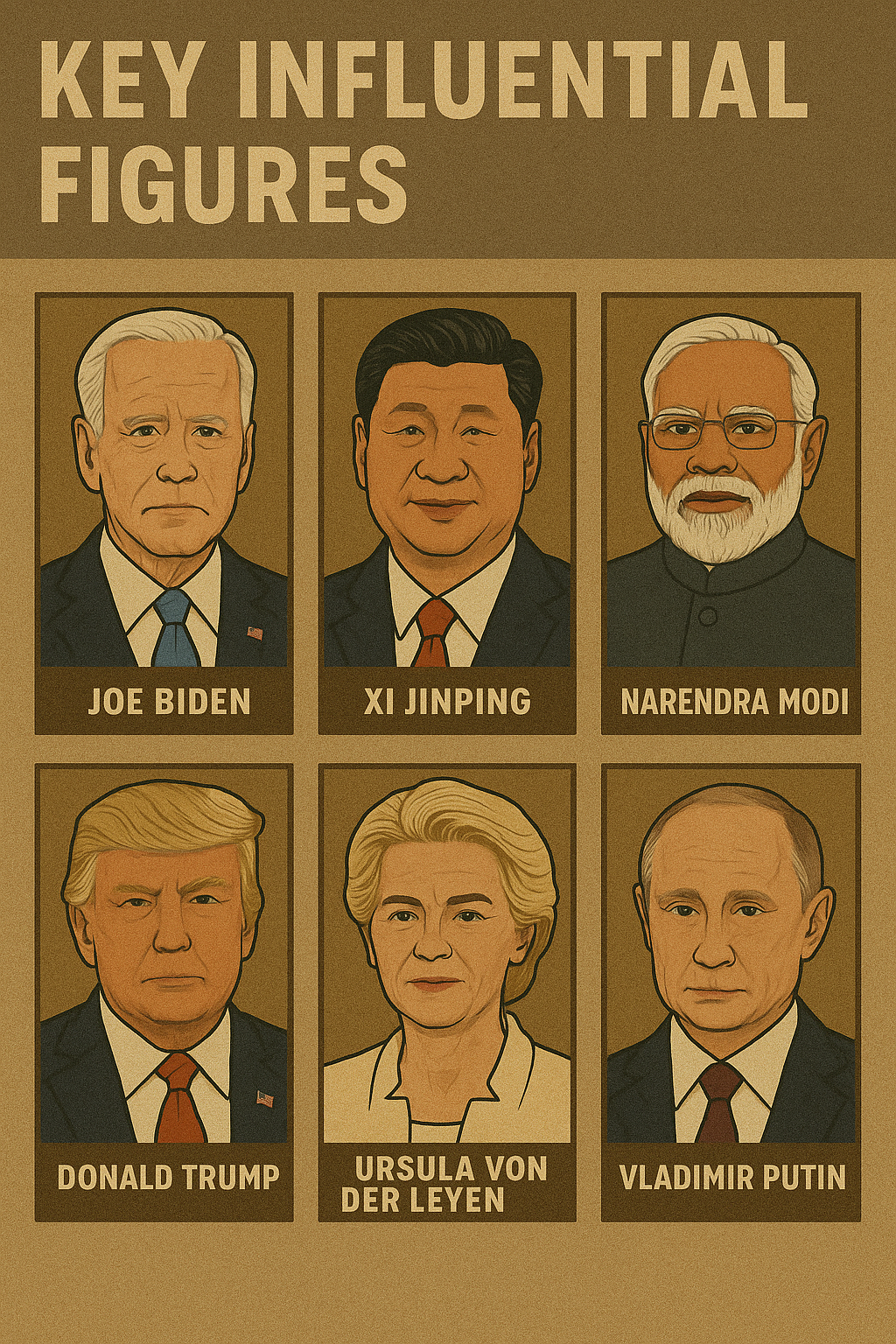
2. Xi Jinping – President of China
Role & Impact
Xi remains at the center of global transformation through tech-led economic growth, greenhouse gas emissions, Belt & Road expansion, and military assertiveness in the South China Sea and Taiwan Strait.
Critical Reflection
Under Xi, China has enacted aggressive state-led globalization and surveillance policies. Supporters view this as a “peaceful ascendance,” while critics highlight concerns about digital authoritarianism, debt diplomacy, and territorial aggression.
3. Vladimir Putin – President of Russia
Role & Impact
Putin has reasserted Russia as a central player on the world stage, leveraging energy exports, military modernization, and digital influence operations to project power from Eastern Europe to the Middle East and beyond. Under his leadership, Russia has hosted major global events, expanded its nuclear capabilities, and built strategic alliances while positioning itself as a counterweight to Western institutions and NATO.
Critical Reflection
Though credited by supporters with restoring national pride, economic stability (particularly in the 2000s), and global stature, Putin’s tenure is marred by authoritarian measures: the crackdown on free media and political opposition, the manipulation of electoral processes, the 2014 annexation of Crimea, and the full-scale invasion of Ukraine in 2022. Human rights organizations cite widespread abuses, and critics warn that power remains heavily centralized around his personal network.
4. Ursula von der Leyen – President of the European Commission
Role & Impact
Under her leadership, the EU has launched initiatives on clean energy (Fit for 55), digital markets, military autonomy, and green industrial policy. Her vision includes positioning Europe as a climate, data, and regulatory power.
Critical Reflection
Supporters praise her steps toward EU autonomy; critics note that consensus among 27 member states is often elusive, leaving projects half-finished. Europe’s global influence often depends on both vision and delivery.
5. Narendra Modi – Prime Minister of India
Role & Impact
Modi has turned the world’s largest democracy into a strategic heavyweight and climate partner with solar diplomacy, tech-driven finance, and global vaccine production.
Critical Reflection
While applauded for economic growth and global engagement, Modi’s record is controversial: critics point to rising religious tensions, suppression of dissent, and growing centralization of power.
6. Kristalina Georgieva – IMF Managing Director
Role & Impact
Georgieva leads the IMF’s global economic strategy during inflation, energy shocks, and debt burdened developing nations. She has advocated for debt relief and climate financing mechanisms.
Critical Reflection
Some argue that the IMF still enforces Western-style austerity and conditionality. Georgieva has pushed for modernization but must balance institutional inertia with inclusive reform.
7. Greta Thunberg – Climate Activist
Role & Impact
Though not a policymaker, Thunberg remains a global voice bridging youth activism and global climate discourse. Her recent appearance with aid convoys to Gaza and COP28 underscores her intertwined commitment to climate and justice.
Critical Reflection
Supporters commend her moral clarity and youth mobilization. Critics argue her style oversimplifies complex geopolitics and that her influence, while symbolic, lacks structural leverage in international forums.
8. Amina J. Mohammed – UN Deputy Secretary-General
Role & Impact
Former Nigerian environment minister Mohammed now drives UN agendas on Sustainable Development Goals, inclusion, and humanitarian action. Her insider perspective brings policy vision and execution focus.
Critical Reflection
Though highly respected, her impact is confined by UN resource constraints and politics. Critics say she must better bridge policy commitments with concrete finance, especially for Global South countries.
Broad Reflections on Leadership in 2025
A. The Power of Narratives
Whether shaping climate urgency, trade norms, or wartime messaging, these leaders wield narratives as much as policy. Their speeches, social media, and public diplomacy define both global mood and mobilization.
B. Institutional Constraints
Even powerful organizations such as the UN, IMF, EU face structural checks. Leaders must navigate veto powers, internal opposition, entrenched bureaucracy, and global geopolitics.
C. Balancing Domestic vs. Global Roles
Many face electoral cycles, nationalism, and economic pressures. Global leadership often competes with domestic priorities, complicating international commitments.
D. The Role of Accountability
With media scrutiny, lawsuits, NGOs, and social media, leaders are under more pressure than ever. Public approval, legal limits, and reputation shape not only what they can do, but what they dare do.
Table: Quick Overview
| Name | Role & Agenda | Strengths | Criticisms |
| António Guterres | UN diplomacy, climate advocacy | Moral authority, global visibility | Constrained by politics and bureaucracy |
| Xi Jinping | China’s global rise and strategic assertiveness | Development leadership, digital tech | Authoritarianism, regional coercion |
| Vladimir Putin | National Resurrection, Key Global Player & Energy Power | Resilient, Influential, Strategic leadership | Authoritarianism, Aggressive Policies, Repression |
| Ursula von der Leyen | EU green & digital leadership | Regulatory innovation, climate policy | EU fragmentation, slow consensus |
| Narendra Modi | India’s growth, solar diplomacy | Vote-winning reforms, vaccine leader | Civil liberties, religious tension |
| Kristalina Georgieva | Global economic stability | Debt relief, inclusion | IMF’s historical austerity baggage |
| Greta Thunberg | Youth climate activism | Moral clarity, public mobilization | Symbolic influence, lack of policymaking |
| Amina Mohammed | UN development and inclusion | Global agenda-setting | UN funding and political bottlenecks |
Conclusion: Leadership in a Fragmented World
In 2025, global affairs are influenced not just by structures but by individuals who define strategies, debates, and values. They guide complex institutions, challenge global norms, and connect with civil society. Yet they also face institutional limits, domestic backlash, and credibility tests.
Understanding these key figures and critically evaluating their successes and shortcomings is essential for anyone studying global affairs. Their actions shape events, underlying rules and responses to challenges like climate breakdown, inequality, conflict, and digital transformation.
References
https://www.economist.com/leaders/2025/06/20/climate-leadership-new-voices
https://www.politico.eu/article/european-union-cop28-ursula-von-der-leyen/
https://www.whitehouse.gov/briefing-room/statements-releases/
https://www.state.gov/secretary-ant%C3%B3nio-guterres/
https://www.imf.org/en/About
https://www.brookings.edu/event/india-aspirations-and-emergence/
https://www.theguardian.com/environment/greta-thunberg-news
https://www.un.org/deputy-secretary-general/
https://www.ft.com/content/global-leadership-2025