
All About Myanmar
Discover Myanmar studies to explore the country’s rich legacy and modern transformation.
Myanmar: The Timeless Treasure of Southeast Asia
Myanmar: The Golden Land
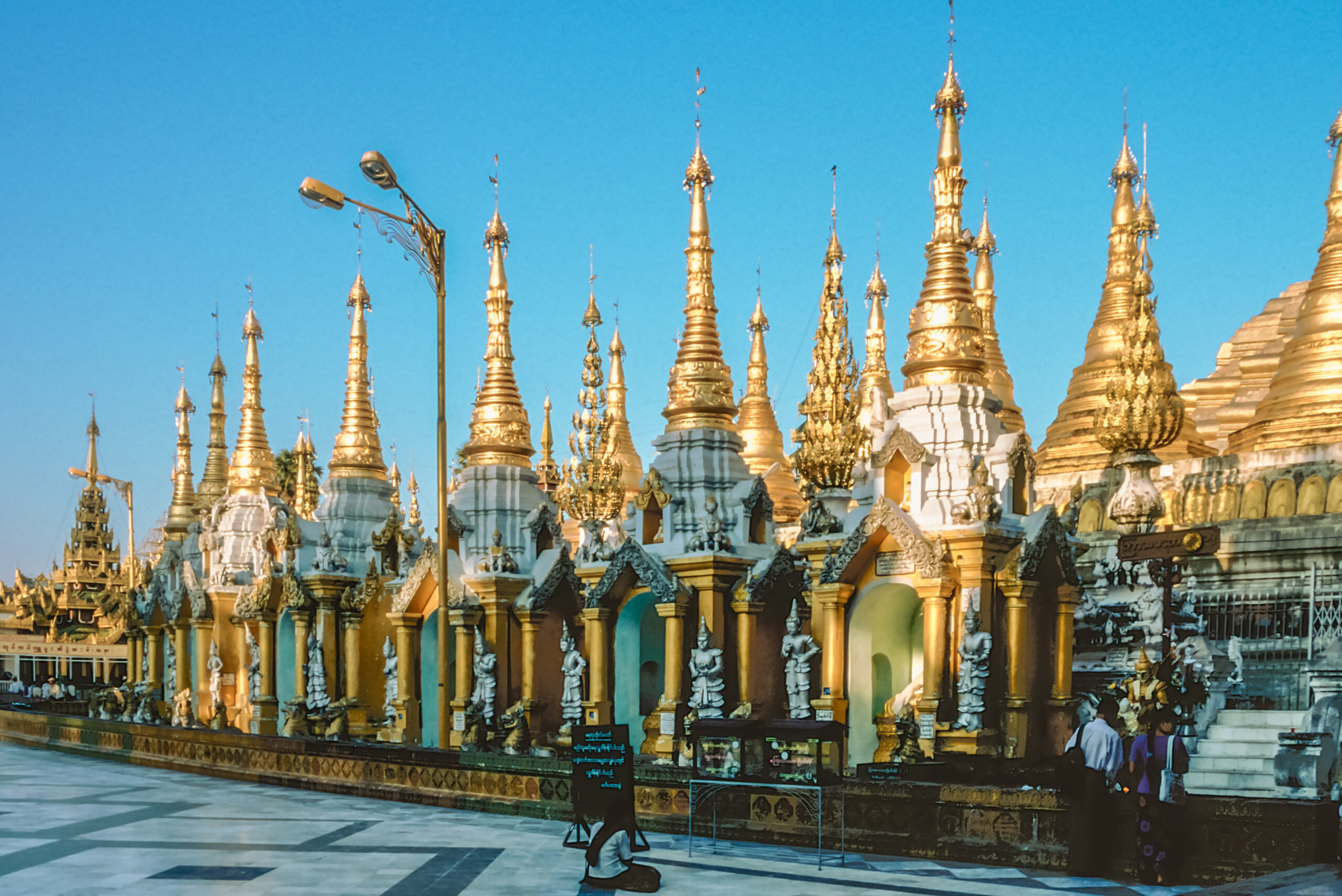
Myanmar, often called the “Land of Golden Pagodas,” is a country where landscapes and traditions shape every journey. Snow-covered peaks in the far north slowly give way to wide plains, before reaching serene beaches along the Andaman Sea. The Irrawaddy River, running the length of the nation, carries traders, pilgrims, and farmers, linking mountains with coast. It is along this river and across these valleys that countless communities have lived for centuries.
Culture and Traditions
Festivals bring people together in ways that feel both joyous and deeply meaningful. Thingyan in April fills streets with water, music, and laughter as families celebrate the New Year. Later, during Thadingyut, candlelight and lanterns brighten pagodas and homes in honor of teachers and elders. In Taunggyi, the skies come alive during Tazaungdaing when hot-air balloons rise and glow in the night. Daily customs are equally striking: thanaka paste gives a golden touch to cheeks, the longyi is tied neatly by men and women alike, and teashops buzz with conversations over sweet milk tea.
Languages and Diversity
Myanmar is a country where landscapes, traditions, and creativity combine into an experience that is both beautiful and unforgettable. To walk among its pagodas, taste its food, and share in its celebrations is to feel a culture that has grown strong over centuries. It remains one of Asia’s treasures, waiting to be explored with curiosity and respect.
While Burmese is the main language, the country is home to more than a hundred others. In Shan State, along the Karen hills, or in Mon coastal towns, different tongues carry their own songs, stories, and poetry. Many people grow up speaking several languages, moving easily between school, home, and marketplace. This mix of voices makes Myanmar one of Asia’s richest cultural tapestries.
Culinary Delights
Food here is as memorable as the scenery. Mohinga, a fish noodle soup flavored with lemongrass, is often served at breakfast tables. Laphet thoke, a salad of fermented tea leaves, peanuts, and garlic, is shared at family gatherings and teashops. Shan noodles reflect the tastes of the highlands with their tomato broth and garlic oil. At roadside stalls, visitors discover treats like coconut rice cakes, banana fritters, and sticky rice roasted in bamboo.
Art, Architecture, and Spiritual Beauty
Bagan is perhaps Myanmar’s most iconic landscape, with over two thousand temples spread across the plains, glowing at sunrise and sunset. In Yangon, the Shwedagon Pagoda stands tall and golden, surrounded by pilgrims and monks. Further south, Kyaiktiyo, known as the Golden Rock, balances dramatically on a cliff, drawing thousands of visitors each year. Alongside these landmarks, traditional crafts continue to thrive: lacquerware, puppetry, glass mosaics, and bamboo weaving are still taught by artisans to younger generations.
Natural Wonders and Wildlife
Beyond the pagodas, nature flourishes. Inle Lake is famous for stilt houses and fishermen who row with one leg while balancing nets. Hkakaborazi National Park shelters red pandas, orchids, and snow leopards in the far north. Ngapali Beach remains one of Asia’s most peaceful coastal escapes, with palm trees lining clear water. The Mergui Archipelago, with its hundreds of islands, is home to coral reefs, dolphins, and the nomadic Moken people.
Youth and Creativity
Myanmar’s younger generation is adding new energy to old traditions. Students study coding and science alongside their languages. Artists paint murals across Yangon’s streets, while filmmakers tell stories rooted in local communities. Musicians and writers draw inspiration from history but give it a modern voice. Their creativity shows how the country’s culture is both preserved and renewed.
Why Explore Myanmar
Every journey here offers discovery. The warmth of local people leaves lasting memories. Markets overflow with colors, sounds, and flavors. Rivers, temples, and coastlines create a sense of wonder that lingers long after departure.
Conclusion
Myanmar is a country where landscapes, traditions, and creativity combine into an experience that is both beautiful and unforgettable. To walk among its pagodas, taste its food, and share in its celebrations is to feel a culture that has grown strong over centuries. It remains one of Asia’s treasures, waiting to be explored with curiosity and respect.
The Geography of Myanmar: Landscapes, Regions, and Strategic Importance
Introduction
Myanmar, formerly known as Burma, is a country of breathtaking geographical diversity, stretching from the Himalayas in the north to the Andaman Sea in the south. Its geography has profoundly shaped its history, culture, economy, and politics. From fertile river valleys and rugged highlands to rich coastal plains and dense forests, Myanmar’s physical geography sustains millions while also determining its strategic role in regional affairs. This article explores Myanmar’s major geographical features, regional divisions, climate zones, resource distribution, and how its geography influences development and geopolitics.
I. Location and Borders
- Location: Myanmar is situated in Southeast Asia and serves as a bridge between South Asia and East Asia.
- Latitude/Longitude: Roughly between 9° and 28° N, and 92° and 101° E.
- Bordering countries:
- China (northeast)
- India and Bangladesh (northwest)
- Thailand and Laos (southeast)
- Coastline: Over 1,930 km long, bordering the Bay of Bengal and the Andaman Sea, making Myanmar a key maritime player in the Indian Ocean region.
II. Major Geographic Regions
Myanmar can be divided into five major physical regions:
1. The Northern Mountains
- Form part of the Eastern Himalayan range
- Includes Myanmar’s highest peak: Hkakabo Razi (5,881 m), the tallest in Southeast Asia
- Sparsely populated, with many ethnic minorities like the Rawang and Kachin
- Rich in minerals and forests but underdeveloped due to terrain and conflict
2. The Central Dry Zone
- Enclosed by the Arakan Yoma to the west and Shan Plateau to the east
- Receives the least rainfall (less than 1,000 mm/year)
- Centered around the Irrawaddy River
- Home to major cities: Mandalay, Magway, and Naypyidaw
- Dominated by agriculture (especially legumes, sesame, cotton)
3. The Shan Plateau
- Covers eastern Myanmar; elevations range from 1,000 to 1,500 meters
- Ethnically diverse: home to the Shan, Palaung, Wa, and others
- Plateau is dissected by deep river valleys and limestone caves
- Economically important for tea, fruit, and mining
4. The Coastal Region (Rakhine and Tanintharyi)
- Narrow coastal strips facing the Bay of Bengal and Andaman Sea
- Rich in marine resources and natural gas
- Important ports: Sittwe, Dawei, and Myeik
- Rainforest ecosystem supports biodiversity and agriculture (betel, palm, rubber)
5. The Irrawaddy River Basin
- The economic and cultural heart of Myanmar
- Irrawaddy River flows over 2,100 km, from north to south
- Fertile delta supports dense agriculture and is prone to seasonal flooding
- Yangon, the largest city, sits in the southern delta
III. Rivers and Water Systems
Major Rivers:
- Irrawaddy River: Lifeline of Myanmar, used for transport, irrigation, and fishing
- Salween River: Flows through remote areas of Shan and Karen States
- Chindwin River: Major tributary of the Irrawaddy
- Sittaung River: Located east of Yangon, supports hydroelectric dams
These rivers are vital for:
- Irrigation in rural areas
- Fishing and aquaculture
- Trade and cargo movement
- Hydropower potential
IV. Climate Zones
Myanmar’s climate is tropical monsoon, with three major seasons:
- Hot Season (March to May)
- Rainy Season (June to October)
- Cool Season (November to February)
Climate Variations:
- Central Dry Zone: Semi-arid with high temperatures
- Coastal and Delta Regions: Heavy rainfall (up to 5,000 mm/year), especially prone to cyclones
- Highland Areas: Cooler, more temperate
The climate plays a crucial role in:
- Agricultural planning
- Risk of natural disasters (especially floods and cyclones)
- Water resource management
V. Biodiversity and Natural Resources
Myanmar is one of the most biologically diverse countries in Asia:
- Home to elephants, tigers, leopards, and rare bird species
- Large tracts of rainforest and bamboo forests
- Important environmental regions: Hukaung Valley, Tanintharyi forests, Inle Lake
Natural Resources:
- Teak, bamboo, and hardwood forests
- Rubies and jade (especially in Kachin and Sagaing)
- Natural gas and oil reserves (especially offshore in the Bay of Bengal)
- Gold, tin, copper, and rare earth minerals
While resource wealth is high, management remains poor due to conflict, corruption, and illegal trade.
VI. Challenges Related to Geography
- Natural Disasters
- Cyclones like Nargis (2008) caused over 130,000 deaths
- Seasonal flooding affects hundreds of thousands annually
- Deforestation and poor land use exacerbate erosion and landslides
- Accessibility and Development
- Mountainous and conflict-prone regions remain underdeveloped
- Many areas lack paved roads, rail, or internet access
- Environmental Degradation
- Deforestation for logging and agriculture
- Mining and dam construction harming river ecosystems
- Urbanization causing pollution in cities like Yangon and Mandalay
VII. Strategic and Economic Importance of Myanmar’s Geography
Myanmar’s geography gives it immense strategic value:
- Access to landlocked Chinese provinces like Yunnan
- Maritime gateway to the Indian Ocean
- Transit hub potential for energy pipelines and highways (China–Myanmar Economic Corridor, Trilateral Highway)
This has led to:
- Chinese port and pipeline investments
- Indian and ASEAN trade corridors
- Competition for influence among regional powers
However, its potential remains underdeveloped due to political instability and armed conflict.
Conclusion
Myanmar’s geography is both a gift and a burden. Its diverse landscapes, fertile plains, and rich resources make it one of the most promising countries in the region. Yet its rugged terrain, vulnerability to natural disasters, and uneven development pose enormous challenges. Geography has shaped Myanmar’s history of kingdoms, its colonial conquest, and its modern struggles. Today, it continues to define Myanmar’s economic opportunities and geopolitical value. To unlock its full potential, Myanmar must invest in inclusive development, environmental sustainability, and peaceful management of its diverse and resource-rich regions.
Myanmar’s Bagan Era: Golden Age of Culture, Power, and Legacy
Introduction
The Bagan Era (9th to 13th century CE) stands as one of the most magnificent chapters in Myanmar’s history. Often referred to as the country’s first true “golden age,” Bagan was a political and military center but also a cultural and religious powerhouse. Nestled along the Irrawaddy River, the Bagan Kingdom laid the foundations for modern Myanmar through its architecture, Buddhist devotion, centralized governance, and lasting identity. Understanding the Bagan Era is essential to appreciating Myanmar’s place in Asian civilization and its enduring cultural soul.
Founding of the Bagan Kingdom
Bagan was founded in the mid-9th century by King Anawrahta, widely credited with unifying much of present-day Myanmar. Anawrahta came to power in 1044 and set out to consolidate scattered city-states and tribal regions under a single Theravāda Buddhist kingdom. His military campaigns and administrative reforms brought political unity, transforming Bagan into the first centralized empire in Burmese history.
Anawrahta’s most significant contribution, however, was ideological: he adopted Theravāda Buddhism, replacing local animist and Hindu beliefs, and made it the spiritual and moral foundation of his kingdom. This shift reshaped religion, education, law, and kingship across Myanmar.
Religious Transformation and Buddhist Patronage
Theravāda Buddhism flourished during the Bagan era, supported by royal patronage and massive temple-building projects.
- Thousands of pagodas and monasteries were constructed between the 11th and 13th centuries, which are over 10,000 religious structures, of which about 2,000 still stand today.
- The kingdom became a magnet for monks, scholars, and pilgrims from Sri Lanka, India, and Cambodia.
- Notable temples include Ananda Temple, Shwezigon Pagoda, and Dhammayangyi Temple, with each representing artistic and engineering excellence.
Religion wasn’t just for worship; it was the center of education, ethics, and politics. Kings earned legitimacy by sponsoring Buddhist teachings and maintaining moral conduct (known as Dhamma).
Art, Architecture, and Literature
Bagan became a flourishing center of Burmese art and innovation. Its legacy includes:
- Stucco reliefs, murals, and bronze images showcasing both Buddhist stories and traditional Jataka tales.
- Pyu script and Mon influences blended into the earliest forms of Burmese writing.
- The preservation of Buddhist scriptures on palm-leaf manuscripts laid the foundation for Myanmar’s literary heritage.
Bagan’s architectural style combined Indian, Sri Lankan, and indigenous elements, creating a distinct Burmese aesthetic that would influence pagodas and monasteries for centuries to come.
Political Structure and Governance
Bagan was a centralized monarchy where the king held supreme power but was guided by religious values. The king was seen as a protector of the faith and ruled with a council of nobles, monks, and military officials.
Key features included:
- A land-tax system that supported temple construction and the livelihoods of monks
- Administrative divisions that allowed semi-autonomy in outer regions
- Alliances formed through royal marriages and religious diplomacy
The strength of the Bagan government lay in its ability to blend statecraft and spirituality, ensuring both loyalty and moral authority.
Foreign Relations and Cultural Exchange
Bagan was not isolated. The kingdom maintained active trade and religious ties with neighboring powers:
- Sri Lanka and Bagan exchanged monks, manuscripts, and relics, deepening Theravāda ties.
- Indian influence persisted in sculpture, astronomy, and medicine.
- Maritime trade with China and Southeast Asia brought wealth and diversity.
Bagan’s openness helped it remain a cultural melting pot while preserving its national identity.
Decline of the Bagan Kingdom
By the late 13th century, Bagan began to weaken. Factors contributing to its decline include:
- Overuse of land and water resources due to temple-building and growing populations
- Loss of royal revenue from tax-exempt religious lands
- Internal rebellion and succession struggles
- The Mongol invasions under Kublai Khan in the 1280s, which shattered the capital’s defenses
In 1287, Bagan collapsed as a central power, fragmenting into smaller kingdoms. Yet its cultural and religious legacy endured.
Legacy of the Bagan Era
Despite its political fall, Bagan left a legacy that shaped Myanmar’s identity for centuries.
- The widespread practice of Theravāda Buddhism in Myanmar today began in Bagan.
- Modern Burmese script and language evolved from the Pyu and Mon writing systems used in this era.
- Myanmar’s traditional view of kingship as a righteous, dharma-guided role also stems from the Bagan model.
- Today, Bagan is a UNESCO World Heritage Site and remains a powerful symbol of national pride, religious devotion, and historical continuity.
Conclusion: Why Bagan Still Matters
Bagan was more than a kingdom, because it was a cultural renaissance and the spiritual birthplace of modern Myanmar. Its temples still inspire awe, not just for their beauty, but for what they represent: a moment when art, politics, religion, and power converged to create a unified civilization.
In modern Myanmar, amidst political unrest and cultural uncertainty, Bagan remains a reminder of what unity, belief, and vision can achieve. To study Bagan is to learn about the roots of Burmese identity and the heights to which a society can rise when guided by both purpose and wisdom.
The Rise and Legacy of the Taungoo Dynasty: Rebuilding a Burmese Empire
Introduction
After the fall of the Bagan Kingdom and centuries of fragmentation, Myanmar was politically divided and vulnerable. But in the 16th century, a new force emerged: the Taungoo Dynasty, which reunited the country and built one of the largest empires in Southeast Asia at the time. Known for military strength, administrative innovation, and cultural influence, the Taungoo era marked a powerful resurgence of Burmese statecraft and identity. Stretching from the mid-1500s to the mid-1700s, the dynasty’s legacy still resonates in the structure of the modern Myanmar state.
The Founding of the Taungoo Dynasty
Taungoo, originally a minor principality in central Myanmar, rose to prominence under King Mingyinyo in the late 15th century. However, it was his son, King Tabinshwehti (reigned 1531–1550), who began uniting Upper and Lower Burma following the decline of the Ava Kingdom.
- Tabinshwehti captured Hanthawaddy (Pegu) and made it his new capital, linking the rice-rich delta with the dry zone kingdoms.
- His rule was marked by ethnic integration, as Burmans, Mons, and other groups came under one crown.
His assassination in 1550 created temporary chaos but it was his brother-in-law who would truly transform Taungoo into a dominant regional empire.
Bayinnaung: The Empire Builder
King Bayinnaung (reigned 1551–1581) is arguably the greatest Burmese monarch in history. Under his leadership, the Taungoo Empire reached its peak.
Military Expansion
Bayinnaung launched aggressive campaigns and conquered vast territories:
- Unified all of modern-day Myanmar
- Subjugated parts of Thailand (Ayutthaya), Laos, and Manipur
- Controlled crucial trade routes from Bengal to the Mekong River
Administration and Control
To maintain such a vast empire, Bayinnaung:
- Introduced vassal systems: local rulers pledged loyalty but retained autonomy
- Reinstated Theravāda Buddhism as a unifying ideology
- Standardized weights, measures, and legal codes, including the Dhammathat (Buddhist law)
His capital at Hanthawaddy became a center of administration, religion, and diplomacy.
Cultural and Religious Achievements
Aside from conquests, the Taungoo Dynasty saw a cultural revival:
- Restored and rebuilt Buddhist monasteries, linking their rule with religious legitimacy
- Fostered Pāli learning and encouraged religious missions with Sri Lanka
- Promoted Burmese as the administrative language, spreading it across regions
Architecture flourished as temples and palaces were rebuilt, often reflecting both Mon and Burmese influences.
Internal Strains and Decline
The death of Bayinnaung led to instability. His son, Nanda Bayin, failed to hold the empire together:
- Subject kingdoms revolted (notably Ayutthaya, which regained independence)
- External enemies like the Portuguese and Siamese pushed back
By the early 17th century, the empire had shrunk significantly. The dynasty moved its capital back north to Ava (Inwa) and rebranded itself as the Restored Taungoo Dynasty (1597–1752).
The Restored Taungoo Dynasty: Reforms Over Conquest
Under rulers like Anaukpetlun and Thalun, the focus shifted from conquest to consolidation.
Political Reform
- Reduced the power of local nobles through centralized administration
- Created a standing army loyal to the king
- Introduced regular censuses and land surveys to boost taxation and control
Religious and Cultural Stability
- Expanded support for the Sangha (monastic order)
- Rebuilt irrigation and temples destroyed in prior wars
Despite a lack of new conquests, these reforms stabilized the kingdom and laid the foundations for future dynasties.
Fall of the Taungoo Dynasty
By the early 18th century, internal rebellion and external pressure returned. The Mon rebellion in Lower Burma led to the sack of Ava in 1752, marking the end of the Taungoo Dynasty.
However, the ideas, structures, and institutions it created would endure into the Konbaung Dynasty (1752–1885) and even into British colonial and post-colonial Myanmar.
Legacy of the Taungoo Era
The Taungoo Dynasty is remembered for more than just war:
- It reunified Myanmar after centuries of division
- It codified laws and centralized authority, key features of the modern state
- It established Burma as a regional power in mainland Southeast Asia
King Bayinnaung remains a national hero, celebrated for his vision and strength. The era proved that unity was possible and that Myanmar could be both powerful and culturally rich.
Conclusion: Lessons from Taungoo
The story of Taungoo is one of ambition, strategy, and resilience. In an age of regional rivalries and political uncertainty, the dynasty showed how military force, religious unity, and administrative reforms could build lasting order. It reminds Myanmar and the world that empires rise by learning how to govern wisely.
The Konbaung Dynasty: Myanmar’s Final Monarchy and the Clash with Modernity
Introduction
The Konbaung Dynasty (1752–1885) was the last royal dynasty of Myanmar, rising in the aftermath of Taungoo’s collapse and ending with British colonization. It was a period marked by ambitious kingship, military expansion, administrative reform, and ultimately, confrontation with the global forces of imperialism. The dynasty’s rulers sought to restore Burmese greatness, reclaim lost territories, and modernize state institutions. But as European colonial powers advanced across Asia, the Konbaung kings faced a new kind of enemy: one that could not be defeated by force alone.
Origins: Rebuilding a Broken Kingdom
In 1752, the Mon rebellion overthrew the Restored Taungoo Dynasty and sacked Ava. Out of the chaos emerged Alaungpaya, a village chief from Shwebo, who declared himself king and began reconquering Upper and Lower Burma.
- By 1757, Alaungpaya had defeated the Mons and reestablished control over the Irrawaddy Delta.
- He founded the Konbaung Dynasty, naming it after his hometown of Konbaung.
Alaungpaya emphasized both military might and legitimacy through Buddhist patronage, echoing past great rulers like Anawrahta and Bayinnaung.
Military Conquests and Territorial Expansion
Under Alaungpaya and his successors Hsinbyushin, Bodawpaya, and Bagyidaw, the Konbaung Empire expanded:
- Manipur and Assam in the west were conquered
- Major wars were fought against Siam (Thailand), including the devastating sack of Ayutthaya in 1767
- Chinese invasions during the 1760s were successfully repelled in the Sino–Burmese Wars
However, these constant wars overextended the kingdom’s resources and led to instability in frontier regions.
Administrative Reforms and Governance
Realizing the need for stronger institutions, the Konbaung kings implemented major reforms:
- Introduced centralized taxation and land surveys
- Reorganized the military into a standing force with firearms
- Created a new legal code, the Manugye Dhammathat, based on Buddhist principles
They also centralized royal authority by curbing the power of hereditary nobles and promoting merit-based appointments.
Buddhism and Culture
Konbaung rulers were fierce patrons of Theravāda Buddhism, continuing a legacy from Bagan and Taungoo.
- Bodawpaya built the massive Mingun Pagoda, though it was never completed.
- Monastic education was promoted; nearly all boys received some education in monasteries.
- Burmese script, literature, and art flourished with court-sponsored chronicles like the Hmannan Yazawin documenting the history of kings.
They also enforced religious conformity, banning some local practices and promoting orthodoxy especially in the wake of religious reforms from Sri Lanka.
The British Encounters and the Three Anglo-Burmese Wars
First Anglo-Burmese War (1824–1826)
- Triggered by Burmese expansion into Assam and Manipur.
- Resulted in devastating Burmese defeat.
- Treaty of Yandabo forced the loss of Assam, Manipur, Arakan, and Tenasserim.
- Burma had to pay 1 million pounds in indemnity, making it a severe economic blow.
Second Anglo-Burmese War (1852)
- Sparked by trade disputes in Rangoon.
- Lower Burma was annexed, including the vital port city of Rangoon.
Third Anglo-Burmese War (1885)
- Britain, eager to dominate all of Southeast Asia and fearing French influence, launched a final war.
- King Thibaw, the last monarch, was overthrown.
- Mandalay was captured without major resistance.
- Burma was annexed and became part of British India.
Modernization Efforts and Missed Opportunities
Some kings, particularly King Mindon (1853–1878), saw the dangers of European power and tried to modernize:
- He created Myanmar’s first newspaper (Yadanapon), promoted foreign missions, and opened secular schools.
- Established Mandalay as a new royal capital, a cultural hub still respected today.
- Convened the Fifth Buddhist Council to reform and preserve the Pāli Canon.
- Attempted to industrialize, with factories for arms, textiles, and printing but the efforts were modest compared to British power.
Mindon also drafted the first Burmese Constitution-like document, balancing monarchy with administrative reforms but his son Thibaw lacked his foresight.
The Fall of the Konbaung Dynasty
When British forces arrived in 1885, they claimed they were ending tyranny and protecting trade. In truth, they sought full control of Burma’s resources and strategic position.
- King Thibaw, unprepared and unpopular, surrendered.
- He and Queen Supayalat were exiled to India.
- Buddhist monks and rural resistance fought back through the Saya San Rebellion and other uprisings but British rule was firmly established.
The fall of the Konbaung Dynasty ended 1,000 years of Burmese monarchy.
Legacy and Impact
Though the Konbaung Dynasty ended in conquest, it left a powerful legacy:
- Cultural preservation: Burmese literature, art, and Buddhist learning reached new heights
- National identity: The dynasty helped forge a collective memory of independence and sovereignty
- Resistance symbol: Konbaung kings, especially Mindon and Thibaw, became symbols of anti-colonial pride
- Historical lessons: It showed both the promise and limits of traditional monarchy in the face of global modernity
Today, cities like Mandalay, the Konbaung royal seat, remain spiritual and cultural centers.
Conclusion: The Final Flame of Burmese Royal Power
The Konbaung Dynasty was Myanmar’s last stand as an independent empire before colonialism. It carried the flame of Bagan and Taungoo forward, mixing Buddhist values, strong kingship, and administrative reform. Yet it could not overcome the technological and imperial might of Europe. Still, its rulers left behind more than ruins and pagodas as they passed down a vision of unity, cultural strength, and resilience that inspires Myanmar to this day.
Colonialism in Myanmar: Invasion, Exploitation, and the Seeds of Resistance
Introduction
Clolonialism was one of the most transformative and traumatic periods in Myanmar’s history. From the annexation of territory by the British Empire in the 19th century to the dismantling of Myanmar’s monarchy and the restructuring of its economy and society, colonial rule changed the country’s political destiny and cultural landscape. While it brought infrastructure, modern education, and trade opportunities, it also imposed foreign domination, extracted wealth, and fractured the nation’s unity. Understanding colonialism in Myanmar is key to grasping its modern struggles with identity, nationalism, and state-building.
I. The Three Anglo-Burmese Wars: Step-by-Step Colonization
First Anglo-Burmese War (1824–1826)
- Caused by border tensions in Assam and Manipur, and rising British suspicion of Burmese expansion.
- The Treaty of Yandabo (1826) forced Burma to cede Assam, Arakan, and Tenasserim to the British.
- The war cost Burma heavily both financially and politically and signaled British ambitions in the region.
Second Anglo-Burmese War (1852)
- Triggered by disputes over trade and treatment of British merchants in Rangoon.
- Led to the annexation of Lower Burma, including the key port of Rangoon.
- Economic exploitation of rice, teak, and oil began to escalate.
Third Anglo-Burmese War (1885)
- Justified by claims of corruption and French influence in the Burmese court.
- British troops captured Mandalay and exiled King Thibaw, ending centuries of monarchy.
- In 1886, Burma was fully incorporated into British India as a province.
II. Political Reorganization and Loss of Sovereignty
Once under full British rule, Myanmar was governed directly from Calcutta and later Delhi:
- The monarchy was abolished, and the Buddhist Sangha (monkhood) lost state patronage.
- Burmese civil servants were excluded from key government roles.
- The British imported Indian administrators, soldiers, and merchants, reshaping Burma’s demographic balance.
Impact: Burmese people lost both political power and cultural authority in their own land.
III. Economic Transformation and Resource Exploitation
British colonialism restructured Myanmar’s economy to serve imperial needs:
- Rice production became the centerpiece of colonial export policy as Burma became the world’s largest exporter by 1930.
- Land was privatized and taxed heavily, often leading farmers to fall into debt and lose their land to Indian moneylenders.
- Forests were cleared for teak, and oil fields were monopolized by foreign companies.
Infrastructure like railroads and ports were developed but mostly to aid extraction and export, not domestic development.
IV. Social and Cultural Disruption
Colonial rule created deep divisions within Burmese society:
- The monastic education system, once central to literacy and moral life, was replaced by secular, English-language schools.
- Burmese culture and language were marginalized in elite education and administration.
- The rise of a foreign commercial class (mainly Indian and Chinese immigrants) fueled resentment among native Burmese.
Colonialism also changed the urban-rural divide: cities became commercial hubs dominated by non-Burmese elites, while the countryside remained poor and unstable.
V. Rise of Nationalism and Anti-Colonial Resistance
Colonial oppression sparked the birth of Burmese nationalism:
- Saya San Rebellion (1930–1932): a massive peasant uprising led by a former monk, protesting land loss and economic hardship.
- Dobama Asiayone (“We Burmese Association”): formed by educated youth advocating national identity and independence.
- Buddhist monks, students, and rural farmers played leading roles in anti-colonial protests.
Symbols of unity like the peacock, traditional dress, and native language became tools of resistance.
VI. The Road to Independence
After World War I, a growing call for self-rule swept across the colony:
- The British offered limited reforms—but true power stayed with colonial authorities.
- World War II changed everything: Burma became a major battlefield between Japanese and Allied forces.
During the war:
- Some Burmese nationalists, including Aung San, allied with the Japanese in hopes of independence.
- Later, disillusioned, they turned against Japan and sided with the Allies.
In 1947, Britain agreed to Burmese independence. Aung San helped negotiate the Panglong Agreement, aiming to unify ethnic minorities. But he was assassinated months later.
On January 4, 1948, Burma officially gained independence without becoming part of the British Commonwealth.
VII. Long-Term Effects of Colonialism
Colonialism left behind deep scars:
- Ethnic divisions: British policies of “divide and rule” created distrust between Burmans and ethnic minorities, which still fuels civil wars today.
- Weakened institutions: The monarchy, monastic education, and local governance were destroyed and never fully restored.
- Economic inequality: The rural poor remained impoverished, while the urban elite benefited from colonial structures.
However, colonialism also contributed to:
- Modern education and political ideas: The emergence of a modern middle class and democratic aspirations
- Infrastructure foundations: Roads, railways, and communication networks
- Global awareness: Burmese leaders learned from Indian, Chinese, and Western anti-colonial movements.
Conclusion: A Legacy of Loss and Awakening
The colonial period was a time of profound loss of sovereignty, cultural continuity, and economic control. Yet it also awakened a national consciousness, forged through resistance and struggle. Understanding this history is not about glorifying the past or blaming the present, but about realizing how Myanmar’s journey toward independence was shaped by both pain and resilience. Today’s political challenges, ethnic divisions, and calls for reform are still echoes of the colonial legacy and can only be resolved by learning from it.
The Geopolitics of Myanmar: Location, Infrastructure, and Investment in Asia’s Crossroads
Introduction
Myanmar’s geopolitical importance has grown sharply in recent decades. Wedged between India and China, facing the Bay of Bengal, and connecting Southeast Asia with South Asia, Myanmar sits at a critical nexus of trade, energy, security, and diplomacy. Its natural resources, ranging from jade and gas to timber and rare earth minerals add to its strategic weight. Despite its political instability and internal conflicts, global powers and regional neighbors continue to compete for influence in Myanmar through infrastructure investments, diplomatic ties, and strategic corridors. This article explores four major elements of Myanmar’s geopolitical relevance: its strategic location and resources, China’s Belt and Road Initiative (BRI), the India–Myanmar–Thailand Trilateral Highway, and foreign investment patterns involving Japan, China, and Singapore.
I. Strategic Importance of Myanmar: Geography and Resources
Myanmar’s Location as a Strategic Pivot
- Geographically, Myanmar connects two of the world’s most populous countries India and China and provides access to the Bay of Bengal, a critical point for maritime trade.
- It borders five countries: China, India, Thailand, Laos, and Bangladesh.
- For China, Myanmar offers direct sea access to the Indian Ocean, bypassing the Malacca Strait chokepoint. This is essential to China’s energy security strategy.
- For India, Myanmar is key to its “Act East” policy, enhancing connectivity with Southeast Asia and countering Chinese influence.
Natural Resources
Myanmar is one of the most resource-rich countries in the region:
- Natural gas and oil: Offshore gas fields like Yadana and Shwe are vital exports.
- Jade and precious stones: Hpakant in Kachin State is one of the world’s richest jade sources.
- Timber and teak: Forests in northern Myanmar have supplied global wood markets for centuries.
- Rare earth minerals and metals: Used in electronics and military technology.
- Agriculture and fisheries: Still a backbone of the rural economy and a significant export sector.
These resources drive Myanmar’s domestic economy and also make it a target for foreign exploitation and investment, particularly by neighboring giants.
II. The Belt and Road Initiative: China’s Gateway to the West
China’s Infrastructure Push in Myanmar
As part of its trillion-dollar Belt and Road Initiative (BRI), China has invested heavily in infrastructure projects across Myanmar. The centerpiece of this strategy is the China–Myanmar Economic Corridor (CMEC).
Key CMEC Projects Include:
- Kyaukphyu Deep-Sea Port: Located in Rakhine State, this port will give China direct access to the Indian Ocean.
- Oil and Gas Pipelines: Completed in 2013–2015, these pipelines run from Kyaukphyu to Kunming in China, reducing China’s reliance on the Strait of Malacca.
- Muse–Mandalay–Kunming Highway and Railway: Designed to link southern China to central Myanmar and onward to the Bay of Bengal.
- Industrial Zones: Planned near Mandalay and Kyaukphyu to boost Chinese manufacturing and trade influence.
Strategic Implications
- These projects allow China to diversify its trade routes, secure energy supplies, and expand political influence.
- However, many local communities and ethnic groups oppose Chinese projects, accusing them of land grabs, environmental destruction, and poor labor practices.
- Myanmar’s military also balances Chinese investment with caution, wary of becoming overly dependent on Beijing.
Post-Coup Dynamics
After the 2021 coup, China maintained relations with Myanmar’s junta but remained pragmatic:
- It avoided open support, focusing on protecting its investments and pipeline routes.
- China has engaged with both the junta and ethnic armed groups to ensure stability around CMEC routes.
III. India–Myanmar–Thailand Trilateral Highway and Regional Trade
The Trilateral Highway: Bridging South and Southeast Asia
India, Myanmar, and Thailand have jointly developed a 1,360-kilometer highway corridor connecting Moreh (India) to Mae Sot (Thailand) via Tamu, Kalewa, and Yangon in Myanmar.
Aims and Benefits:
- Strengthen regional integration under India’s Act East policy.
- Enhance trade and mobility for landlocked Northeast India.
- Counterbalance China’s CMEC and BRI dominance in the region.
Strategic and Economic Significance
- India considers the Trilateral Highway crucial for accessing Southeast Asian markets and building alternative supply chains.
- For Myanmar, it offers a multipolar economic strategy, reducing dependency on China.
- Thailand and ASEAN see it as a way to bring Myanmar deeper into the ASEAN Economic Community.
Challenges
- Delays due to poor infrastructure in Myanmar and internal conflict zones.
- India’s infrastructure development lags behind China’s, weakening its competitiveness.
- Security concerns, especially in Sagaing Region and Chin State, disrupt logistics and construction.
IV. Foreign Investment: Japan, China, and Singapore
Japan’s Investment Model: Infrastructure and Stability
Japan is one of Myanmar’s most consistent and respected investors, even during political upheavals. It focuses on quality infrastructure and sustainable development, with a long-term view of Myanmar’s democratization.
Key Investments:
- Thilawa Special Economic Zone (SEZ) near Yangon – a flagship project with Japanese standards of efficiency.
- Urban planning and transit in Yangon and Mandalay.
- Energy and water management systems in rural and peri-urban areas.
Japan often works through public-private partnerships and provides Official Development Assistance (ODA) rather than just loans.
Even post-coup, Japan has tried to balance moral condemnation with pragmatic engagement, keeping channels open for future transition support.
China’s Deep Economic Footprint
China remains Myanmar’s largest trading partner and a dominant investor in energy, mining, infrastructure, and manufacturing.
Key Chinese Investments:
- Hydropower projects like Myitsone (suspended due to public backlash) and other dams in Shan and Kachin States.
- Telecommunications via companies like Huawei and ZTE.
- Mining and construction across ethnic states, often in conflict zones.
China’s role is strategic but controversial:
- Many Chinese projects are seen as non-transparent and extractive.
- Public opinion in Myanmar tends to be suspicious of China’s political motives, despite economic benefits.
Singapore’s Financial Role
While not as politically involved as China or Japan, Singapore is Myanmar’s top source of approved foreign direct investment (FDI).
Why Singapore?
- It serves as a financial and legal hub for global firms operating in Myanmar.
- Many companies register in Singapore due to its strong regulatory environment and tax benefits.
Singapore’s neutral image, strategic distance, and elite networks make it ideal for:
- Real estate investment
- Telecommunications
- Banking and insurance
However, post-2021, several Singaporean banks and companies have reduced exposure due to reputational risks.
Conclusion: Myanmar in the Global Chessboard
Despite internal challenges like ethnic conflicts, political instability, and international sanctions, Myanmar remains a high-value geopolitical prize. It connects competing powers: China, India, ASEAN, and the West. Its geography grants access to seas and borders, while its resources tempt investment and exploitation. The CMEC and Trilateral Highway reflect a strategic tug-of-war between Chinese and Indian influence. Meanwhile, Japan and Singapore offer alternative models of investment and development.
Going forward, Myanmar’s ability to leverage its location and resources wisely, while ensuring inclusive governance and local participation, will determine whether it becomes a bridge for regional growth or a battleground for foreign control.
Refrences: